Yellow Grass in Your Lawn: What’s Wrong and How to Fix It
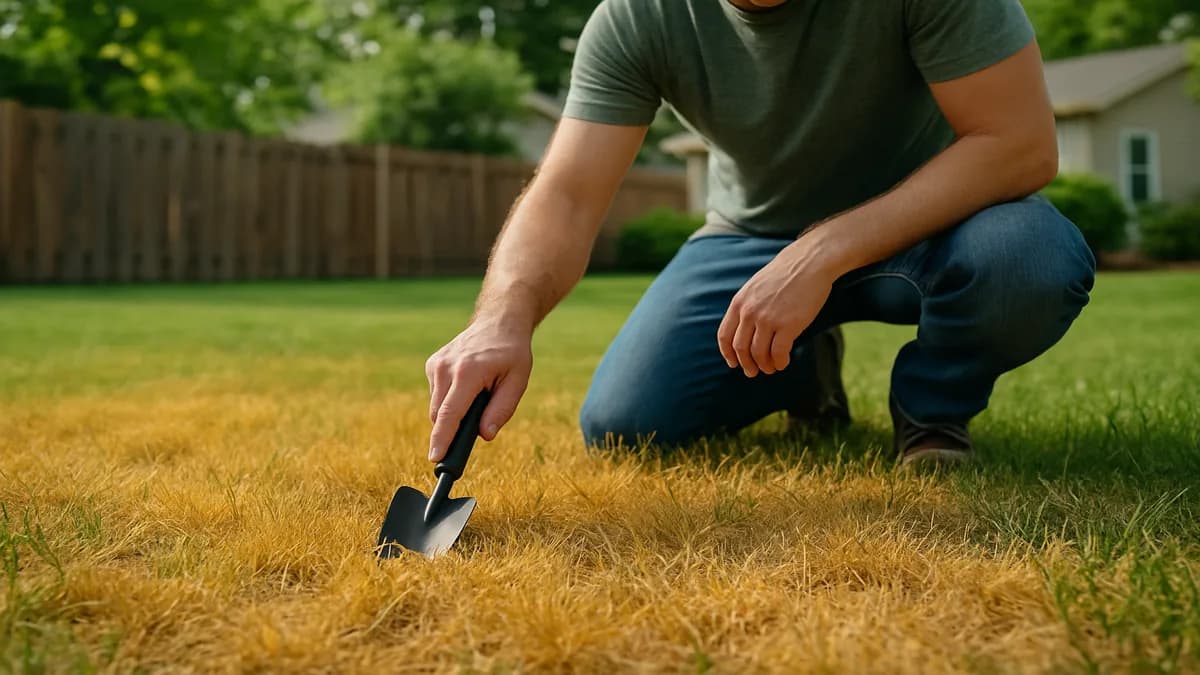
Yellow grass can be a quick fix or a sign of bigger trouble. Learn how to spot the difference, what to do first, and which mistakes to avoid.
On this page
- What Yellow Grass Patterns Tell You
- 1. Nitrogen Deficiency: The Classic Case
- 2. Overwatering: Drowning Roots
- 3. Dog Urine: Burned Spots with a Green Halo
- 4. Iron Chlorosis: Yellow Between the Lines
- 5. Yellow Patch and Other Lawn Diseases
- Yellow Patch (Cool-Season Lawns)
- Brown Patch (Warm-Season Lawns)
- Dollar Spot
- Rust
- 6. Grubs: The Patchy, Peeling Problem
- 7. Other Causes (and How to Spot Them)
- Quick Diagnostic Checklist
- Fix Priority Table
- Where People Mess Up
- When to Skip the Fix
- Calculators for Real Numbers
- Want to Dig Deeper?
You’re staring at yellow grass and wondering: Is it dead? Can I fix it? Do I need to fertilize, water, or just start over? Here’s how to read the clues, figure out what’s really happening, and get your lawn back on track,without wasting money on the wrong fix.
What Yellow Grass Patterns Tell You (opens in a new tab)
Most yellow grass isn’t a mystery if you know what to look for. The pattern,scattered spots, rings, or a uniform wash,points straight to the cause. Here’s how to match the symptom to the problem:
| Yellow Pattern | Likely Cause | Quick Check | Best First Fix |
|---|---|---|---|
| Uniform pale yellow | Nitrogen deficiency | Lawn looks hungry, slow growth | Fertilize |
| Small yellow spots w/ green ring | Dog urine | Near paths, 4-12" wide | Flush & reseed |
| Large yellow rings/arcs | Yellow patch disease | Cool, wet weather | Improve airflow |
| Yellow between leaf veins | Iron chlorosis | New leaves yellow first | Iron spray |
| Irregular patches, turf lifts | Grubs | Turf peels up, animals dig | Treat grubs |
| Mushrooms, spongy soil | Overwatering | Soggy, footprints linger | Water less |
| Yellow stripes | Fertilizer burn | Follows spreader path | Water deeply |
| High-traffic yellowing | Soil compaction | Hard soil, stunted grass | Aerate |
1. Nitrogen Deficiency: The Classic Case (opens in a new tab)
If your whole lawn is fading to a pale yellow and growing slowly, odds are it’s starving for nitrogen. This is especially common after heavy rain, in sandy soils, or if you haven’t fertilized since spring.
What usually happens: Homeowners skip a feeding, or rain leaches nutrients out. The grass struggles, especially cool-season types like perennial ryegrass.
How to fix it:
- Apply 1 lb of actual nitrogen per 1,000 sq ft. For a 24-0-6 fertilizer, that’s about 4 lbs of product per 1,000 sq ft.
- Water in well.
- Expect green-up in 7-14 days if weather is warm.
Worked example: Say you have 2,500 sq ft and a 32-0-4 bag. You want 1 lb N per 1,000 sq ft: 2.5 lbs N total. 32% N means 2.5 / 0.32 = about 8 lbs of product for your whole lawn.
2. Overwatering: Drowning Roots (opens in a new tab)
If your lawn feels squishy, mushrooms are popping up, and the yellowing is patchy or widespread, you’re probably watering too much. Roots suffocate, nutrients leach away, and grass turns yellow or even dies.
How to check:
- Push a screwdriver into the soil a day after watering. If it slides in 6 inches or more with no resistance, soil is saturated.
- Footprints linger? That’s a sign of soggy turf.
How to fix it:
- Cut back to 1 inch of water per week (including rain).
- Water deeply but less often,once or twice a week, not daily.
- Aerate compacted areas if water pools.
3. Dog Urine: Burned Spots with a Green Halo (opens in a new tab)
Small yellow or brown spots (4-12 inches across) with a dark green edge, especially near walkways or fences, almost always mean dog urine. The center burns from too much nitrogen and salt; the edge gets a fertilizer boost and turns extra green.
How to fix it:
- Flush the spot with water within a few hours of the dog’s visit.
- Rake out dead grass and reseed with a matching grass type.
- Train your dog to use a mulched or gravel area if you can.
Skip-it scenario: If you don’t have pets or the spots are nowhere near where a dog could go, skip this cause and look for grubs or disease instead.
4. Iron Chlorosis: Yellow Between the Lines (opens in a new tab)
Yellowing between the veins of grass blades, especially on new growth, hints at iron chlorosis. This is common in alkaline soils (pH above 7.5), especially in the western U.S. or where irrigation water is hard.
How to confirm:
- A soil test will show high pH and normal iron levels.
- The yellowing is sharp: veins stay green, tissue between turns yellow.
How to fix it:
- Apply chelated iron as a foliar spray for quick results (lasts a few weeks).
- For a long-term fix, lower soil pH with elemental sulfur, but this is slow and takes repeated applications.
5. Yellow Patch and Other Lawn Diseases (opens in a new tab)
Yellow Patch (Cool-Season Lawns) (opens in a new tab)
- Shows up as yellow rings/arcs, 6 inches to 3 feet wide, in spring or fall.
- Caused by a fungus (Rhizoctonia cerealis) in cool, wet weather.
- Grass inside the ring may look normal or thin.
What to do:
- Improve airflow (prune, mow high, don’t overwater).
- Water early in the day so leaves dry quickly.
- Skip heavy nitrogen in cool, wet months.
- Fungicides are rarely needed,yellow patch is mostly cosmetic and fades as weather dries out.
Brown Patch (Warm-Season Lawns) (opens in a new tab)
- Circular yellow-to-brown patches, often with a dark edge, in hot, humid weather.
- Same cultural fixes: water early, avoid excess nitrogen, improve airflow.
Dollar Spot (opens in a new tab)
- Silver-dollar-sized bleached spots that merge into larger patches.
- Usually from low nitrogen; light, regular feeding helps.
Rust (opens in a new tab)
- Orange-yellow powder on blades and shoes. Grass looks thin, slow-growing.
- Fix: Fertilize and mow regularly.
Common mistake: Spraying fungicide for every yellow spot. Most yellowing isn’t disease. Save your money unless you’ve ruled out water, nutrients, and mowing.
6. Grubs: The Patchy, Peeling Problem (opens in a new tab)
Irregular yellow or brown patches that lift up like a cheap carpet? That’s grubs eating the roots. You’ll often see skunks or birds digging for a snack.
How to check:
- Peel back a patch. Find more than 5-10 white, C-shaped grubs per square foot? Time to treat.
How to fix it:
- Apply a grub control product labeled for your grass type, following directions.
- Water in well.
- Reseed or patch dead spots after grubs are gone.
7. Other Causes (and How to Spot Them) (opens in a new tab)
- Mowing too short: Scalped lawns show yellow or brown stubble, especially on slopes or high spots. Raise your mower to 2.5-4 inches for most grasses.
- Dull mower blades: Frayed, whitish-yellow tips. Sharpen blades every 20-25 mowings.
- Fertilizer burn: Bright yellow or brown stripes where the spreader overlapped or skipped. Water deeply to flush excess salts.
- Soil compaction: High-traffic areas look thin, yellow, and feel hard. Aerate in spring or fall.
- Dormancy: Warm-season grasses like zoysiagrass turn straw-yellow below 55°F soil temp. Nothing to fix,wait for warm weather.
- Spring transition: Patchy green-up is normal as lawns wake up. Give it a few weeks before panicking.
Quick Diagnostic Checklist (opens in a new tab)
Look at the pattern
Is yellowing uniform, patchy, ringed, or striped? That narrows it down fast.Check the soil
Screwdriver test: If you can’t push it in 6 inches, soil is compacted or dry. If it’s mushy, you’re overwatering.Tug test
If turf lifts easily, check for grubs underneath.Blade inspection
Frayed tips = dull mower. Yellow between veins = iron chlorosis. Uniform yellow = likely nitrogen deficiency.Review your care
When did you last fertilize, water, or mow? Most yellow lawns are hungry or drowning.Soil test
It’s cheap and tells you if pH or nutrients are the problem.
Fix Priority Table (opens in a new tab)
| Problem | What to Do First | When to Act | Typical Cost (per 1,000 sq ft) | Notes |
|---|---|---|---|---|
| Nitrogen deficiency | Fertilize, water in | Spring/Fall | $15-$30 | Use fertilizer calculator |
| Overwatering | Reduce watering, aerate if needed | Immediately | Free-$100 | Use irrigation calculator |
| Dog urine | Flush, reseed | As needed | $10-$20 | Use grass seed calculator |
| Iron chlorosis | Spray chelated iron | As needed | $20-$40 | Repeat every 4-6 weeks |
| Grubs | Apply grub control, reseed | Late spring/summer | $30-$60 | Only treat if >5-10 grubs/sq ft |
| Disease (yellow patch) | Improve airflow, water early | Spring/Fall | Free-$50 | Fungicide rarely needed |
| Compaction | Aerate | Spring/Fall | $50-$100 | DIY or hire out |
Where People Mess Up (opens in a new tab)
What I see most: Folks dump on more fertilizer or fungicide before checking the basics. If you don’t know your soil pH, haven’t checked watering, or haven’t looked for grubs, you’re guessing,and that gets expensive. Always start with the simple stuff.
When to Skip the Fix (opens in a new tab)
If your grass is yellow because it’s dormant (like zoysiagrass in winter or a cool-season lawn in summer heat), there’s nothing to fix. Save your money and effort for when the grass is actively growing.
Calculators for Real Numbers (opens in a new tab)
Want to Dig Deeper? (opens in a new tab)
- What Fertilizer Numbers Mean
- Slow-Release vs Quick-Release Fertilizer
- Liquid Aeration vs Core Aeration
- How to Get Rid of Crabgrass
- How to Get Rid of Dandelions
- Perennial Ryegrass and Zoysiagrass grass types
Yellow grass isn’t a death sentence. Nine times out of ten, you can get your lawn green again with the right fix,just don’t guess. Use the patterns, check your basics, and you’ll save yourself a lot of hassle.
Frequently asked questions
Calculators for this job
Fertilizer Calculator
Turf guidance is written in pounds of nitrogen per 1,000 sq ft, but fertilizer is sold as a percentage analysis. This converts between them for any bag you have, enter the three numbers on the front.
OpenIrrigation Calculator
Find out how much water your lawn or garden actually needs each week, in both inches and gallons, and how to split it across the week for your soil type.
OpenGrass Seed Calculator
Seeding rates differ by species by a factor of twenty, bermudagrass wants 1 lb per 1,000 sq ft, perennial ryegrass wants 8. Pick your grass and whether you're starting fresh or overseeding.
OpenKeep reading
Perennial Ryegrass: Fast Green-Up, Smart Uses, and Where It Falls Short
Perennial ryegrass seed is your shortcut to a green lawn,if you use it right. Here’s how to seed, blend, and care for it, plus where it works and where it fizzles.
7 min read
Zoysiagrass: What to Know Before You Plant (and How to Keep It Happy)
Zoysiagrass makes a thick, weed-fighting lawn but takes patience and goes brown for months. Here’s how to plant, care for, and decide if zoysia fits your yard.
7 min read
Tall Fescue: The Cool-Season Workhorse for Real Yards
Tall fescue is a practical cool-season grass for transition-zone lawns, but it grows in bunches and needs overseeding to stay thick.
9 min read
Spotted something out of date or wrong? Tell us , we correct guides rather than leaving them to rot.