Topdressing Your Lawn: Real Advice for Healthier, Smoother Grass
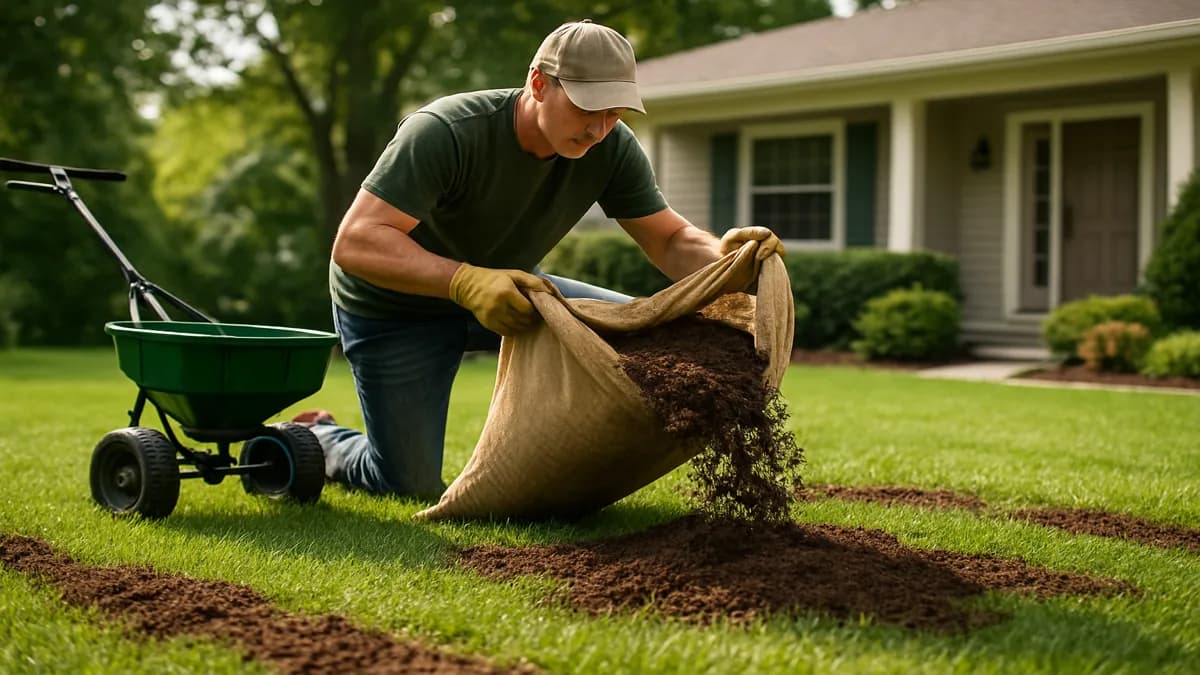
Topdressing means spreading a thin layer of compost or soil over your lawn to fix bumps, improve soil, and help grass grow. The trick is never to bury the grass.
On this page
- What Does Topdressing a Lawn Do?
- What Material Should You Use for Topdressing?
- How Much Topdressing Material Do You Need?
- When Should You Topdress Your Lawn?
- How to Topdress a Lawn: Step-by-Step
- Leveling a Bumpy Lawn With Topdressing
- Worked Example: How Much Compost for a 5,000 sq ft Lawn?
- Common Mistakes (and How to Avoid Them)
- When to Skip Topdressing
- Cost to Topdress a Lawn
- Related Reading
You’re here because your lawn’s bumpy, thin, or just plain tired. Maybe you want to level out some dips, help new seed take, or finally do something about that patchy soil. Topdressing is the answer,if you do it right. Here’s what actually works, what to skip, and how much compost you’ll really need.
What Does Topdressing a Lawn Do? (opens in a new tab)
Topdressing is simply spreading a thin layer of compost, soil, or a blend over your grass. It’s not rocket science, but it’s easy to mess up if you don’t know the limits.
- Improves soil: Compost adds organic matter, feeds microbes, and helps your lawn hold water and nutrients. Most U.S. lawns are low on organic matter, especially if you bag clippings or have sandy or clay-heavy soil.
- Smooths bumps: A thin layer fills shallow dips and evens out minor lumps. Don’t expect miracles in one go.
- Helps new seed: After overseeding, a dusting of compost keeps seed moist and in place. It’s a must for thin or bare spots.
- Breaks down thatch: Compost helps soil microbes chew through thatch, so you may dethatch less often. For more on that, see power raking vs. dethatching.
What Material Should You Use for Topdressing? (opens in a new tab)
This is where people mess up. The wrong material can make things worse, not better. Here’s what actually works:
| Material | Best For | Watch Out For |
|---|---|---|
| Screened compost | Most lawns, soil improvement | Must be fully finished (no stink, no chunks) |
| Compost-topsoil blend | Leveling, minor dips, adding organic matter | Heavier, may contain weed seeds |
| Screened topsoil | Leveling where you don’t need organics | Adds little biology, can be heavy |
| Sand | Sand-based lawns, golf greens | Never use over clay; causes drainage issues |
| Sand-compost blend | Leveling on sandy soils | Only if sand matches your soil texture |
How to tell if compost is ready:
- Smells earthy, not sour or like ammonia
- No visible food scraps or big wood chunks
- Sifts easily through your fingers
If you’re buying, ask for “screened, finished compost.” If you’re making your own, let it break down fully before using.
How Much Topdressing Material Do You Need? (opens in a new tab)
Here’s where most folks underestimate. A quarter-inch layer is a lot of material. Let’s do the math:
- 1/4 inch deep: 0.77 cubic yards per 1,000 sq ft
- 1/2 inch deep: 1.54 cubic yards per 1,000 sq ft
| Lawn Size (sq ft) | 1/4 inch (cu yd) | 1/2 inch (cu yd) |
|---|---|---|
| 2,000 | 1.5 | 3.1 |
| 5,000 | 3.9 | 7.7 |
| 8,000 | 6.2 | 12.3 |
A 5,000 sq ft lawn at 1/4 inch needs almost 4 cubic yards,about a pickup and a half, or a small dump truck delivery. Bagged compost is only practical for small patches.
When Should You Topdress Your Lawn? (opens in a new tab)
Timing is everything. Topdress only when your grass is actively growing, so it can recover and grow through the new layer.
| Grass Type | Best Time to Topdress | Why |
|---|---|---|
| Cool-season (fescue, bluegrass, rye) | Early fall (Sept-Oct) | Grass is growing strong, less weed pressure |
| Warm-season (Bermuda, zoysia, St. Augustine) | Late spring to early summer (May-June) | Lawn is fully green and growing |
Don’t topdress dormant or stressed grass. It won’t recover, and you’ll just smother it. For more on timing, see how often to overseed your lawn.
How to Topdress a Lawn: Step-by-Step (opens in a new tab)
Mow shorter than usual
Set your mower about half an inch lower than normal and bag the clippings. You want the topdressing to hit soil, not sit on tall grass.Core aerate (optional, but worth it)
Aerate first if you can. It lets compost work into the root zone. See liquid vs. core aeration for options.Drop small piles across the lawn
Wheelbarrow your compost out in small piles every few feet. Don’t dump it all in one spot.Spread and blend
Use a landscape rake, leveling lute, or stiff push broom. Spread until you see grass blades poking through everywhere. That’s your sign to stop.Overseed if needed
If you’re overseeding, do it now. The compost helps hold seed and keeps it moist. For details, check DIY hydroseeding guide.Water lightly
Give the lawn a gentle watering to settle the compost and help it filter down.
Leveling a Bumpy Lawn With Topdressing (opens in a new tab)
Topdressing is great for smoothing minor bumps, but it’s not magic. Here’s what works:
- Minor dips (under 1/2 inch): Fill in one pass.
- Moderate dips (1/2-2 inches): Fill no more than 1/2 inch at a time. Let grass grow through, then repeat in 4-6 weeks.
- Deep dips (>2 inches): Don’t try to bury them. Cut the turf in an H-shape, peel it back, add soil, then lay the turf back. See how to care for new sod if you need to patch.
Worked Example: How Much Compost for a 5,000 sq ft Lawn? (opens in a new tab)
Let’s say you want to topdress at 1/4 inch deep:
- 5,000 sq ft × (1/4 inch ÷ 12 inches) = 104 cubic feet
- 104 cubic feet ÷ 27 = 3.85 cubic yards
So, order 4 cubic yards to be safe. At $50 per yard delivered, that’s $200 for material. Add $50-$100 for delivery, depending on your area.
Common Mistakes (and How to Avoid Them) (opens in a new tab)
- Too thick: Anything over 1/2 inch smothers grass. Always check that blades poke through.
- Wrong material: Sand on clay, unfinished compost, or topsoil full of weed seeds will cause headaches.
- Bad timing: Topdressing dormant, stressed, or heat-stressed lawns leads to dead patches.
- Skipping prep: Not mowing short or skipping aeration means the compost just sits on top.
For more on prepping your lawn, see best ways to clean up leaves and starter fertilizer tips.
When to Skip Topdressing (opens in a new tab)
If your lawn is mostly weeds, bare dirt, or has major drainage problems, skip topdressing for now. Fix the underlying issues first,kill weeds, fix drainage, and get some healthy grass growing before you invest in compost.
Cost to Topdress a Lawn (opens in a new tab)
Bulk compost runs $35-$65 per cubic yard delivered. For a 5,000 sq ft lawn at 1/4 inch, expect $200-$300 for material and delivery. Bagged compost is much pricier per yard,fine for patching, not for whole lawns.
Hiring a pro? Expect $400-$1,000 for a typical yard, depending on size and prep. Most companies combine topdressing with aeration and overseeding.
Related Reading (opens in a new tab)
- What do fertilizer numbers mean?
- How to care for new sod
- How often to overseed your lawn
- Best ways to clean up leaves in your yard
- 9 FAQs about applying starter fertilizer
If you’re not sure what your lawn needs, or you’re dealing with more than just bumps and thin spots, talk to a local extension office or a reputable lawn service. Sometimes, skipping a step saves you time and money in the long run.
Frequently asked questions
Calculators for this job
Compost Calculator
Compost gets applied far thinner than mulch or soil, and the right depth depends entirely on the job. Enter your area and pick the application to get volume, bags, and cost.
OpenTopsoil Calculator
Topsoil is heavy, roughly a ton per cubic yard, so knowing the weight matters as much as the volume. Enter your area and depth for yards, bags, and delivered tonnage.
OpenLawn Area Calculator
Almost every other lawn number depends on this one. Break your yard into simple shapes, subtract the parts that aren't grass, and get a square footage you can use for seed, fertilizer, and quotes.
OpenKeep reading
Starter Fertilizer for New Grass: What Most Homeowners Get Wrong
Starter fertilizer can jumpstart new grass, but using it wrong wastes money or breaks the law. Here’s what to know before you spread.
6 min read
How to Clean Up Leaves Without Wrecking Your Lawn
Mulch-mowing leaves is usually best, but thick layers need removal. Here’s how to clean up leaves the right way for your lawn and climate.
7 min read
What Fertilizer Numbers Really Mean (NPK and Lawn Fertilizer Math)
Wondering what those fertilizer numbers mean? Here’s how to read NPK ratios, why phosphorus is often zero, and how to figure out the right amount for your grass.
7 min read
Spotted something out of date or wrong? Tell us , we correct guides rather than leaving them to rot.