When to Lime Your Lawn (and How Much to Use)
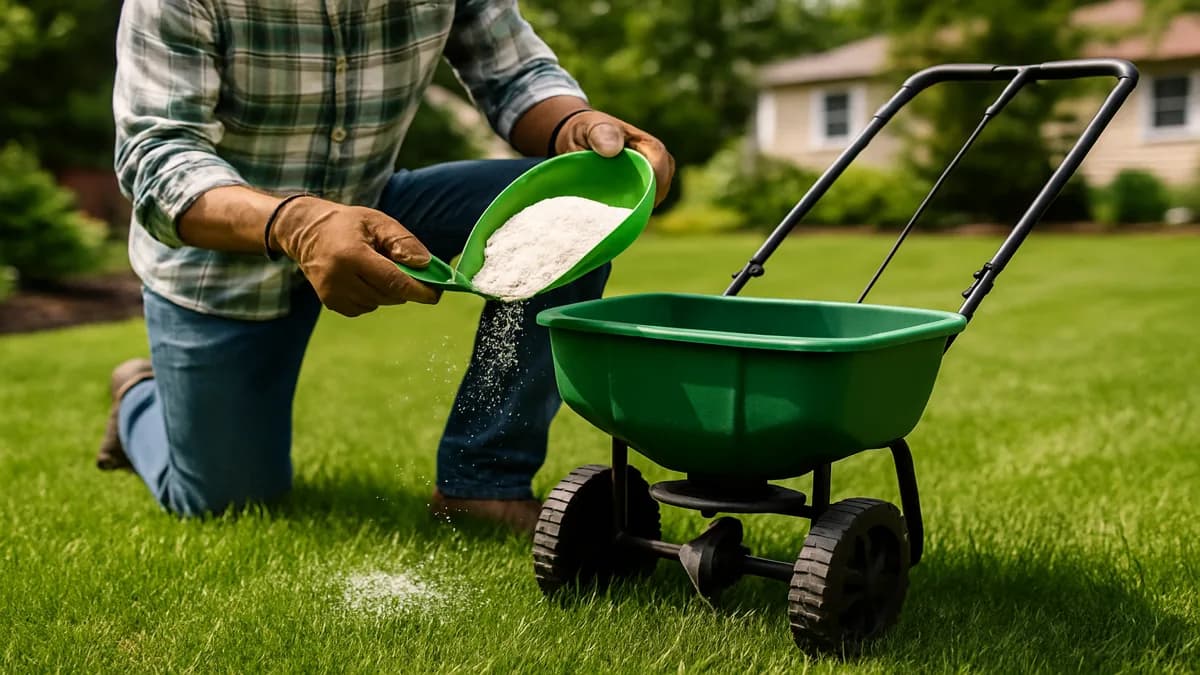
Lime only helps acidic soil. Test first, follow the lab rate, and cap single applications so you raise pH without burning the turf.
On this page
- Why Lawns Need Lime (Sometimes)
- Soil Test First, Always
- When to Apply Lime
- How Much Lime per 1,000 Square Feet
- Calcitic vs Dolomitic vs Pelletized
- How to Apply Lime Without Making a Mess
- What Lime Will Not Fix
- Worked Example
- Lime, Fertilizer, and Seeding Order
- Pelletized vs Ag Lime: Spreading Reality
- Acid Rain Myths and Coastal Soils
- Signs People Mistake for “Needs Lime”
- Mistakes to Skip
- Storage and Leftover Bags
Lime raises soil pH when turf is growing in soil that is too acidic. It does not feed grass the way nitrogen does, and it does nothing useful on alkaline soil. If you have never seen a soil test, do not lime on habit.
Why Lawns Need Lime (Sometimes) (opens in a new tab)
Rainfall, irrigation, and ammonium fertilizers gradually acidify many soils. As pH falls, nutrients already present become less available. Grass can look thin or off-color even after fertilizer applications. Extension guides from Ohio State (opens in a new tab), Arkansas (opens in a new tab), and Kentucky (opens in a new tab) all start with the same rule: test before you lime.
Most common lawn grasses prefer roughly 6.0 to 7.0. Centipedegrass is a notable exception and often prefers more acidic soil. If you grow centipede, do not chase a “neutral” pH just because a bag says every lawn needs lime.
Soil Test First, Always (opens in a new tab)
A surface pH reading tells you acidity. The lime requirement (often based on buffer pH) tells you how many pounds of limestone your specific soil needs. Clay and high-organic soils usually need more lime than sand to make the same pH change.
How to sample and read results: How to Soil Test Your Lawn.
| Test result | Action |
|---|---|
| pH in target range | Do not lime |
| pH low, lime rate listed | Apply lab rate, split if large |
| pH high (alkaline) | Lime will make it worse; ask about iron/sulfur strategies |
| No test, moss present | Diagnose shade/compaction/water before buying lime |
When to Apply Lime (opens in a new tab)
Best windows:
- Fall: Preferred in many regions. Freeze-thaw and winter moisture help incorporation.
- Early spring: Second choice while grass is growing and soils are workable.
- Avoid: Summer heat stress, frozen ground, and drought-dormant turf.
Pacific Northwest lawns often sit on acidic soils, but even there the correct answer is still “only if the test says so.” See the Pacific Northwest lawn care schedule.
How Much Lime per 1,000 Square Feet (opens in a new tab)
Trust the lab rate over any generic chart. For established turf, common extension guidance is:
- If the recommendation is under about 50 lb/1,000 sq ft, apply it in one pass in fall or spring.
- If the recommendation is 50 to 100 lb, split between seasons.
- If it exceeds 100 lb, apply 50 lb per pass, retest, and continue until you reach the target.
Water after application to rinse lime off leaf blades and move particles toward the soil surface (Arkansas Extension (opens in a new tab)).
Calcitic vs Dolomitic vs Pelletized (opens in a new tab)
| Material | What it adds | When to choose |
|---|---|---|
| Calcitic lime | Calcium carbonate | Mg already adequate on the test |
| Dolomitic lime | Calcium + magnesium | Soil Mg is low |
| Pelletized lime | Same chemistry, easier spreading | Homeowner convenience; usually costs more |
| Hydrated / burned lime | Fast, caustic | Generally avoid on home lawns |
Check the bag’s calcium carbonate equivalent (CCE). Lower CCE means you need more product to match the lab’s pure-carbonate recommendation. Ohio State walks through that math in its home-lawn lime fact sheet.
How to Apply Lime Without Making a Mess (opens in a new tab)
Mow and clear debris
A normal mowing height is fine. Pick up leaves or heavy thatch mats that would keep lime from reaching soil.Calibrate the spreader
Use the bag chart as a starting point, then do a quick catch-test so you do not double-overlap at every turn.Apply half-rate in two directions
Cross perpendicular passes for even coverage.Water lightly
Rinse granules off blades. Core aeration before liming can help on compacted lawns, but is not required every time.
What Lime Will Not Fix (opens in a new tab)
- Nitrogen deficiency (you still need a fertilizer plan)
- Iron chlorosis on high-pH soils
- Shade, grubs, dog urine spots, or poor drainage
- Instant color in seven days
If the lawn is yellow and pH is already fine, use the yellow grass diagnostic before buying more limestone.
Worked Example (opens in a new tab)
Soil test for a 6,000 sq ft tall fescue lawn:
- pH 5.5
- Lime recommendation: 80 lb per 1,000 sq ft
- Magnesium: adequate
Plan:
- Buy calcitic pelletized lime.
- Apply 50 lb/1,000 now (300 lb total for 6,000 sq ft).
- Apply the remaining 30 lb/1,000 next season.
- Retest in 12 months.
- Fertilize based on N and K needs, not because the lime “didn’t green it up.”
Lime, Fertilizer, and Seeding Order (opens in a new tab)
A practical sequence for acidic lawns:
- Soil test in late summer or fall
- Apply lime when recommended
- Wait for workable weather, then fertilize on a growth-based schedule
- If overseeding, get seed-to-soil contact after aeration; lime can go on the same renovation weekend if rates are moderate and labels allow
Lime does not replace starter fertilizer rules. New seed still follows phosphorus regulations and starter fertilizer guidance.
Pelletized vs Ag Lime: Spreading Reality (opens in a new tab)
Agricultural ground limestone is usually cheaper per neutralizing unit but dusty and harder to spread evenly with a small broadcast spreader. Pelletized lime costs more and spreads cleanly. Either can work if you match CCE and apply the correct effective rate. Homeowners who routinely leave stripes of untreated acidic soil often “used lime” without changing average pH.
Tips for even coverage:
- Walk a measured calibration path
- Overlap lightly rather than leaving gaps
- Keep the hopper agitator working; pellets can bridge
- Do not apply on windy days if using fine ag lime
Acid Rain Myths and Coastal Soils (opens in a new tab)
Not every brown lawn in a rainy climate needs lime. Some coastal or arid western soils are alkaline and need the opposite mindset (iron management, careful fertilizer choice, no limestone). Always read the pH number. “We get a lot of rain” is not a soil test.
In high-rainfall acidic regions, retesting every couple of years still beats annual blind liming. Once pH is in range, maintenance limestone may be occasional or unnecessary for long stretches.
Signs People Mistake for “Needs Lime” (opens in a new tab)
| Observation | Test first? | Other common causes |
|---|---|---|
| Moss | Yes | Shade, compaction, wet soil |
| Yellow grass | Yes | Nitrogen, iron, water, pests |
| Poor fertilizer response | Yes | Wrong pH or wrong diagnosis |
| Neighbor limed successfully | Yes | Different soil and grass |
Mistakes to Skip (opens in a new tab)
- Liming every spring without a test
- Dumping the whole multi-year rate in one weekend
- Using hydrated lime from a hardware shortcut
- Expecting lime to replace fertilizer scheduling
- Liming centipede toward neutrality because a neighbor’s fescue needed it
- Mixing lime into a soil sample bag and then trusting the report
- Assuming pelletized lime works overnight like nitrogen fertilizer
Storage and Leftover Bags (opens in a new tab)
Keep lime dry. Hardened bags are difficult to spread evenly. If a bag absorbs moisture and turns to brick, break it up thoroughly or discard it rather than leaving chalky clumps that never react uniformly.
Lime is a precision amendment. Used on the right soil, it unlocks fertility you already paid for. Used on the wrong soil, it creates a problem fertilizer cannot solve.
Frequently asked questions
Calculators for this job
Lawn Area Calculator
Almost every other lawn number depends on this one. Break your yard into simple shapes, subtract the parts that aren't grass, and get a square footage you can use for seed, fertilizer, and quotes.
OpenFertilizer Calculator
Turf guidance is written in pounds of nitrogen per 1,000 sq ft, but fertilizer is sold as a percentage analysis. This converts between them for any bag you have, enter the three numbers on the front.
OpenCompost Calculator
Compost gets applied far thinner than mulch or soil, and the right depth depends entirely on the job. Enter your area and pick the application to get volume, bags, and cost.
OpenKeep reading
How to Soil Test Your Lawn (and Actually Use the Results)
A soil test replaces fertilizer guesswork with numbers. Here’s how to sample, read the report, and turn results into a plan.
6 min read
What Fertilizer Numbers Really Mean (NPK and Lawn Fertilizer Math)
Wondering what those fertilizer numbers mean? Here’s how to read NPK ratios, why phosphorus is often zero, and how to figure out the right amount for your grass.
7 min read
Pacific Northwest Lawn Care: What to Do, When, and Why
Here’s how to actually keep a lawn alive and healthy in the Pacific Northwest, from moss battles to the best time to overseed and water.
6 min read
Spotted something out of date or wrong? Tell us , we correct guides rather than leaving them to rot.