Weed and Feed vs Separate Fertilizer and Weed Killer
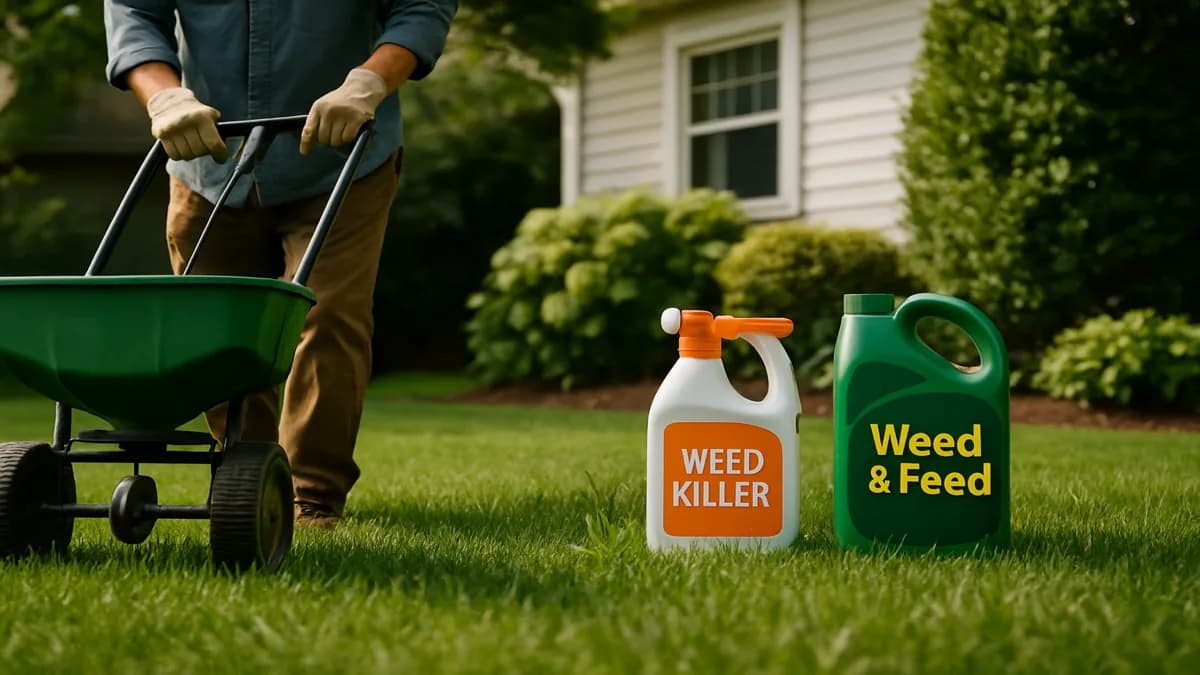
Combo bags are convenient. They are not always correct. Here’s when weed and feed makes sense and when to buy separate products.
On this page
- What “Weed and Feed” Actually Contains
- Decision Table: Combo vs Separate
- When Weed and Feed Makes Sense
- Broadleaf weed-and-feed basics
- When Separate Products Win
- Crabgrass prevention
- New grass and starter programs
- Matching fertilizer to a soil test
- Worked Example: Two Neighbor Lawns
- Label Traps to Read Before You Buy
- Pre-Emergent Combos vs Post-Emergent Combos
- Nitrogen Load Hidden in Combo Bags
- Grass-Type Safety Checklist
- Seasonal Decision Tree
- Practical Buying Rule
Weed and feed promises two jobs in one pass: feed the grass and kill weeds. Sometimes that is exactly what a mature lawn needs. Sometimes it is the reason seed fails, fertilizer runs off dormant turf, or crabgrass still wins in June. The decision is about timing overlap, not brand loyalty.
What “Weed and Feed” Actually Contains (opens in a new tab)
Most consumer weed-and-feed bags combine:
- Fertilizer (an N-P-K analysis)
- Herbicide, either:
- Pre-emergent (stops seeds from establishing), or
- Post-emergent (kills emerged broadleaf weeds like dandelion and clover)
Those herbicide groups are not interchangeable. A spring “crabgrass preventer with fertilizer” is a different tool from a “weed control plus fertilizer” bag aimed at broadleaf weeds already up.
University extension educators have flagged the timing mismatch for years, especially in warm-season regions where early pre-emergent windows arrive while turf is still barely growing (UF/IFAS Extension (opens in a new tab)).
This page covers synthetic combo products. For the organic pre-emergent sold as a natural weed-and-feed, see corn gluten meal.
Decision Table: Combo vs Separate (opens in a new tab)
| Situation | Better choice | Why |
|---|---|---|
| Light broadleaf weeds, grass growing hard | Weed and feed (post-emergent type) | One pass can be enough |
| Crabgrass history, early spring soil 50–55°F | Standalone pre-emergent, fertilize later | Fertilizer often wants later timing |
| Overseeding or new sod this season | Separate products; often skip herbicide | Combos commonly block seed |
| Heavy weed cover, thin turf | Dedicated herbicide, then feed after recovery | Fertilizer feeds weeds too |
| Wrong grass type on the bag | Do not use | Some herbicides injure St. Augustine, centipede, or others |
| Want organic-only approach | Corn gluten or cultural control | Different product class |
When Weed and Feed Makes Sense (opens in a new tab)
Use a combo bag when all of these are true:
- Turf is established and has been mowed several times this season
- Weeds on the label match what you actually have
- Grass is green and growing (not dormant, not heat-stressed)
- You are not seeding, sodding, or laying sprigs in the next label interval
- You can follow leaf-wetness or water-in rules exactly
Broadleaf weed-and-feed basics (opens in a new tab)
Many granular broadleaf products work best when:
- You mow 1 to 2 days before
- You apply to a wet canopy so granules stick to weed leaves
- You delay irrigation and rainfall for the period on the label
- You skip mowing for a couple of days after
Full kill of dandelions and similar weeds can take 1 to 3 weeks. For dedicated broadleaf tactics, see how to get rid of dandelions.
When Separate Products Win (opens in a new tab)
Crabgrass prevention (opens in a new tab)
Crabgrass pre-emergent should be down when soil temperatures approach the mid-50s °F, before seeds germinate. In many regions that window arrives before cool-season lawns want a heavy nitrogen push, and long before warm-season lawns fully green up. A fertilizer combo applied on the “right” early date for herbicide can waste nitrogen or push growth at the wrong time.
For timing and product logic, use the crabgrass guide, then fertilize on a schedule that matches grass growth. A national calendar lives in lawn fertilizer schedule.
New grass and starter programs (opens in a new tab)
Starter fertilizer is about phosphorus rules and seedling roots. Weed-and-feed herbicides often stop those seedlings cold. If you are establishing turf, follow starter fertilizer FAQs and keep herbicides off the plan until the label says the new grass is ready.
Matching fertilizer to a soil test (opens in a new tab)
Combo bags lock you into whatever N-P-K the marketer chose. If a soil test shows high phosphorus and low potassium, a random weed-and-feed analysis can be the wrong feed. Test first (how to soil test your lawn), then pick fertilizer numbers that match (fertilizer numbers explained).
Worked Example: Two Neighbor Lawns (opens in a new tab)
Lawn A: Tall fescue, light dandelions in October, no seeding planned.
Plan: Fall broadleaf weed-and-feed can be reasonable if the label lists dandelion and tall fescue, weather is mild, and granules contact wet weed foliage.
Lawn B: Same street, plans to overseed thin spots in September, history of crabgrass.
Plan: Skip combo bags. Apply spring pre-emergent alone (or accept crabgrass pressure if spring-seeding), fertilize on growth, overseed in fall without herbicide residues that block germination, then spot-treat broadleaf weeds after new grass is established.
Same product aisle. Opposite correct answers.
Label Traps to Read Before You Buy (opens in a new tab)
- Grass species list: “For use on…” is not optional reading
- Seeding interval: Weeks to months before you can safely seed
- Maximum annual rate: Split apps still count toward the yearly cap
- Water-in vs do-not-water: Opposite instructions for different herbicide types
- Temperature limits: Many broadleaf herbicides perform poorly or risk injury in high heat
Pre-Emergent Combos vs Post-Emergent Combos (opens in a new tab)
Retail shelves blur the language. Read the weed list and mode:
Pre-emergent + fertilizer
- Goal: stop crabgrass and other annual weeds from establishing
- Needs to be down before germination
- Often wants irrigation to activate the soil barrier
- Poor partner for a seeding weekend
Post-emergent + fertilizer
- Goal: kill emerged broadleaf weeds while feeding turf
- Needs weeds actively growing and, for many granules, leaf contact
- Often wants dry-down time after application
- Still unsafe for new seed until the label clearance window passes
If the bag says “prevents crabgrass” and “kills dandelions,” confirm both claims and both sets of instructions. Dual-mode products can stack restrictions.
Nitrogen Load Hidden in Combo Bags (opens in a new tab)
Combo products lock fertilizer analysis to the herbicide rate. That means you cannot raise weed control without also raising nitrogen, or cut nitrogen without cutting herbicide. On lawns that only need a light feeding, a heavy combo can push excess growth, clippings, and disease risk in warm weather.
Use the fertilizer calculator after you know the bag’s N percentage and your target pounds of nitrogen per 1,000 square feet. If the combo forces more N than your schedule wants, split products.
Grass-Type Safety Checklist (opens in a new tab)
Before checkout, match the label to your lawn:
- St. Augustine and centipede: many common broadleaf and crabgrass actives are restricted or prohibited
- Zoysia: check cultivar and label carefully
- Tall fescue / bluegrass mixes: usually more options, still not unlimited
- Unknown grass: identify before buying herbicides
A wrong bag can yellow or kill the lawn faster than the weeds would have.
Seasonal Decision Tree (opens in a new tab)
Early spring (soil ~50–55°F): Standalone pre-emergent for crabgrass history. Fertilize later when growth is real.
Mid to late spring: Broadleaf weed-and-feed only if grass and weeds are both growing and no seeding is planned.
Summer heat: Avoid stressful herbicide + fertilizer stacks on wilting turf. Spot-treat carefully if the label allows.
Fall: Strong window for broadleaf control on cool-season lawns; excellent time to separate feed from weed control if soil test numbers are specific.
Any seeding month: Keep herbicide combos off the plan.
Practical Buying Rule (opens in a new tab)
Ask one question at the store:
“Is the fertilizer timing and the herbicide timing both correct this week?”
- Yes → weed and feed can earn its convenience.
- No → buy the herbicide that matches the weed and the fertilizer that matches the soil and season.
Then ask a second question:
“Am I seeding within the label interval?”
If yes, the combo bag goes back on the shelf.
Convenience is a feature. Agronomy is still the boss.
Frequently asked questions
Calculators for this job
Fertilizer Calculator
Turf guidance is written in pounds of nitrogen per 1,000 sq ft, but fertilizer is sold as a percentage analysis. This converts between them for any bag you have, enter the three numbers on the front.
OpenLawn Area Calculator
Almost every other lawn number depends on this one. Break your yard into simple shapes, subtract the parts that aren't grass, and get a square footage you can use for seed, fertilizer, and quotes.
OpenGrass Seed Calculator
Seeding rates differ by species by a factor of twenty, bermudagrass wants 1 lb per 1,000 sq ft, perennial ryegrass wants 8. Pick your grass and whether you're starting fresh or overseeding.
OpenKeep reading
Crabgrass Killer: What Actually Works (and What Doesn’t)
Crabgrass keeps coming back because most folks miss the timing or use the wrong product. Here’s how to kill crabgrass, prevent it, and avoid wasted effort.
7 min read

How to Actually Get Rid of Dandelions (Not Just the Flowers)
Dandelion taproots make them stubborn. Here’s how to remove or kill dandelions so they don’t return, plus when to act and when to just let them be.
6 min read
Corn Gluten Meal for Lawns: Honest Results, Rates, and When to Skip It
Corn gluten meal offers some weed suppression and a hefty nitrogen boost, but it’s pricey, inconsistent, and not for every lawn. Here’s what works, what doesn’t, and how to avoid wasting your money.
7 min read
Spotted something out of date or wrong? Tell us , we correct guides rather than leaving them to rot.