Spring Lawn Care Checklist by Grass Type
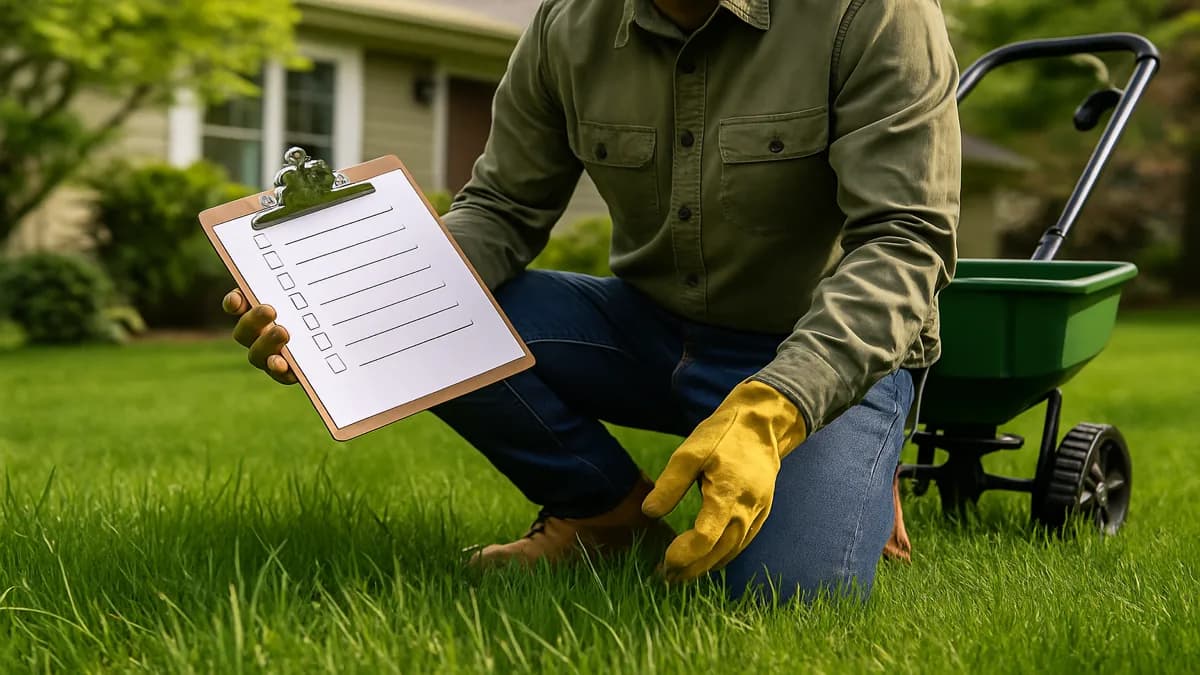
Spring lawn care starts with cleanup and timing. Cool-season lawns need a restrained wake-up, while warm-season lawns wait for full green-up.
On this page
- Quick Spring Sequence
- Step 1: Clean Up Without Smearing the Soil
- Step 2: Measure Before You Treat
- Step 3: Apply Crabgrass Pre-Emergent on Time
- Step 4: Mow High Enough for the Grass You Have
- Step 5: Fertilize by Grass Family, Not Calendar Hype
- Worked Example: First Warm-Season Feeding
- Step 6: Water for Weather, Not Habit
- Step 7: Aerate Only When the Grass Can Recover
- Step 8: Seed Only Where Spring Makes Sense
- Step 9: Make Lime a Test-Based Decision
- Cool-Season Spring Checklist
- Warm-Season Spring Checklist
- When to Skip a Spring Task
- Common Spring Lawn Care Mistakes
Spring lawn care starts with cleanup, timing, and restraint. Rake matted debris, sharpen mower blades, prevent crabgrass before it sprouts, and fertilize only after your grass is actively growing. Cool-season lawns wake up early but do not need a heavy spring push. Warm-season lawns need patience until green-up.
Assumptions for this checklist: you are caring for a US home lawn, you know or can identify whether your grass is cool-season or warm-season, and you will follow product labels plus local fertilizer and pesticide rules. Pair this with the fall lawn care checklist because many spring problems are easier to prevent in fall.
Quick Spring Sequence (opens in a new tab)
Use this before you buy bags or rent equipment. The exact week changes by region, but the order stays steady.
| Spring phase | Cool-season grass | Warm-season grass |
|---|---|---|
| Early thaw / late winter | Remove debris, avoid soggy soil | Remove debris, wait for dormancy to break |
| Soil firms up | Rake matted patches, service mower | Rake lightly, inspect winter injury |
| Before crabgrass germinates | Apply pre-emergent if needed | Apply pre-emergent if needed |
| Active growth begins | Mow high, fertilize lightly if needed | Wait on fertilizer until mostly green |
| Late spring | Watch heat and weeds, avoid major stress | Fertilize, mow regularly, consider aeration |
If your lawn is half bare, treat this checklist as triage. Cleanup and weed timing still matter, but major seeding, grading, or sod may need a separate repair plan.
Step 1: Clean Up Without Smearing the Soil (opens in a new tab)
Start when the lawn is firm enough that your shoes do not sink or leave shiny mud prints. Pick up sticks, trash, toys, and anything that blocks light. Rake leaves that matted over turf, but do not power-rake wet ground just because the first sunny Saturday feels productive.
Light rake work wakes matted blades and exposes snow mold patches to air. Aggressive scraping can pull crowns and roots when soil is saturated. If debris is heavy, make two light passes a few days apart.
| What you see | Spring move | Wait if |
|---|---|---|
| Scattered twigs and leaves | Hand rake or mulch-mow when dry | Soil is soft underfoot |
| Matted turf | Light rake to stand blades up | Grass pulls up easily |
| Winter plow damage | Remove gravel, plan soil repair | Ground is still frozen below |
| Standing water | Mark the spot for drainage work | You would rut the lawn |
| Thick thatch | Diagnose first | You are using thatch as a guess |
Step 2: Measure Before You Treat (opens in a new tab)
Fertilizer, pre-emergent, seed, and lime all depend on lawn area. Measure turf, not the whole lot. Subtract the house, driveway, sidewalks, beds, and patios.
Separate front and back yards if sun, slope, or grass type changes. A south-facing strip near pavement may warm earlier than a shaded backyard, which matters for crabgrass timing and watering.
Step 3: Apply Crabgrass Pre-Emergent on Time (opens in a new tab)
Crabgrass pre-emergent works before crabgrass sprouts, not after you can see a patch. Many homeowners time it around soil temperatures moving into the low to mid 50s F, but your product label and local spring pattern matter most.
Use the first application before germination and a split application only if the label allows it and your region has a long germination window. If you plan to seed, read the label carefully because many pre-emergents also stop desirable grass seed. The crabgrass guide explains how to get rid of crabgrass once prevention is no longer the right tool.
Step 4: Mow High Enough for the Grass You Have (opens in a new tab)
The first mow should clean up growth without scalping crowns. Sharpen the blade, mow dry grass, and remove no more than about one-third of the blade height at a time. If winter left tall uneven tufts, step the height down over two cuts.
Use the species range in lawn mowing height by grass type. Cutting too low in spring exposes soil to weed light and can stress grass right when roots should be building strength.
Step 5: Fertilize by Grass Family, Not Calendar Hype (opens in a new tab)
Spring fertilizer timing is different for cool-season and warm-season lawns. Cool-season grass already did much of its root work in fall, so heavy spring nitrogen can create lush top growth that struggles in summer heat. Warm-season grass should not get a strong nitrogen push until it is mostly green and actively growing.
If you have not tested soil in the last 2 to 3 years, use how to soil test your lawn before adding lime or chasing mystery deficiencies. The full seasonal fertilizer pattern is in the lawn fertilizer schedule.
| Grass family | Spring fertilizer timing | Typical approach |
|---|---|---|
| Cool-season | After green growth resumes, often mid to late spring | Light feeding only if needed |
| Warm-season | After 50% to 75% green-up, then active growth | First real feeding of the season |
| Newly seeded areas | Based on starter label and soil test | Avoid weed preventers that block seed |
| Drought-stressed turf | Wait | Fertilizer cannot replace water |
Worked Example: First Warm-Season Feeding (opens in a new tab)
Say you measured 6,000 square feet of bermudagrass. The lawn is about 70% green and the soil test does not call for a special correction. You choose a 24-0-10 fertilizer and aim for 1 pound of nitrogen per 1,000 square feet.
First, convert the lawn size:
6,000 sq ft ÷ 1,000 = 6
Then calculate product per 1,000 square feet:
1 lb nitrogen ÷ 0.24 = 4.17 lb of product
For the whole lawn:
4.17 × 6 = about 25 lb of fertilizer
The label still controls spreader setting, watering directions, and whether that rate fits the product.
Step 6: Water for Weather, Not Habit (opens in a new tab)
Spring watering depends on rain, soil, wind, and grass type. Do not start daily irrigation just because the system is back on. Check soil moisture first, then water deeply when the lawn actually needs it.
Cool-season grass may need help during dry, windy spells. Warm-season grass coming out of dormancy needs enough moisture to grow, but soggy soil slows warming and invites problems.
| Spring condition | Watering move | Watch for |
|---|---|---|
| Regular rain | Keep irrigation off | Low spots staying soggy |
| Dry wind | Water deeply when soil dries | Wilt or blue-gray color |
| New seed patches | Frequent light moisture at first | Dry crust on the surface |
| Warm-season green-up | Moderate moisture | Cold, wet soil |
Step 7: Aerate Only When the Grass Can Recover (opens in a new tab)
Spring core aeration is a grass-type decision. Warm-season lawns often handle aeration in late spring to early summer after green-up. Cool-season lawns usually recover better from major aeration in fall, especially if you plan to overseed afterward.
If compaction is severe, you may still aerate a cool-season lawn in spring, but keep the expectation modest. For timing by grass family, see when to aerate your lawn.
Step 8: Seed Only Where Spring Makes Sense (opens in a new tab)
Spring seeding is useful for small patches, pet damage, and winter injury. It is not the best broad overseeding window for most cool-season lawns because young seedlings face summer heat before they have deep roots.
If you patch seed, keep pre-emergent away unless the label says it is safe for seeding. For larger renovation, plan late summer or fall and use the fall checklist as your reminder.
Step 9: Make Lime a Test-Based Decision (opens in a new tab)
Do not lime because moss appeared or because the neighbor did. Lime changes soil pH over time, and too much can create new nutrient problems. Use a soil test, then apply the recommended material at the recommended rate.
If pH correction is on the report, spring can work, but fall is often convenient because moisture helps lime begin reacting before the next growing season.
Cool-Season Spring Checklist (opens in a new tab)
Cool-season lawns need a clean, measured start. Their spring growth can look hungry, but fall is usually the stronger feeding and renovation season.
- Clean debris after soil firms.
- Rake matted turf lightly.
- Apply crabgrass pre-emergent before germination if needed.
- Mow within the proper height range.
- Fertilize lightly only after active growth and only if the lawn needs it.
- Patch small bare spots, but save broad overseeding for late summer or fall.
- Watch irrigation as temperatures rise.
Warm-Season Spring Checklist (opens in a new tab)
Warm-season lawns need patience first, then steady care after green-up. Brown bermuda or zoysia in March is often dormancy, not failure.
- Remove debris and let sunlight reach crowns.
- Avoid heavy fertilizer until 50% to 75% green-up.
- Apply pre-emergent before crabgrass germinates.
- Begin mowing as growth becomes regular.
- Fertilize after active growth starts.
- Aerate in late spring to early summer if compaction is present.
- Repair winter-killed patches once warm soil supports recovery.
When to Skip a Spring Task (opens in a new tab)
Skip fertilizer when grass is dormant, drought-stressed, or sitting in cold wet soil. Skip broad overseeding if you also need crabgrass prevention. Skip aeration when the lawn is too wet, too cold, or entering summer stress. Skip lime unless a soil test tells you the pH needs correction.
Skipping is not neglect. It is often the difference between a lawn that grows evenly and a lawn that spends April recovering from good intentions.
Common Spring Lawn Care Mistakes (opens in a new tab)
The most common mistake is treating the calendar like a label. Spring arrives differently in Minnesota, Georgia, Colorado, and Oregon. Soil temperature, green-up, rain, and grass type are better signals than a holiday weekend.
Other mistakes include fertilizing warm-season grass while it is still mostly brown, scalping the first mow, applying pre-emergent after crabgrass has already sprouted, liming without a test, and watering every morning until the soil stays soggy. Keep products simple, write down what you applied, and give each step time to work before adding another one.
Spring care is mostly sequencing. Clean up first, prevent weeds before they germinate, feed after growth starts, and renovate in season. That keeps the lawn moving forward without piling on products it cannot use yet.
Frequently asked questions
Calculators for this job
Lawn Area Calculator
Almost every other lawn number depends on this one. Break your yard into simple shapes, subtract the parts that aren't grass, and get a square footage you can use for seed, fertilizer, and quotes.
OpenFertilizer Calculator
Turf guidance is written in pounds of nitrogen per 1,000 sq ft, but fertilizer is sold as a percentage analysis. This converts between them for any bag you have, enter the three numbers on the front.
OpenKeep reading
Fall Lawn Care Checklist for Cool- and Warm-Season Grass
Fall is renovation season for cool-season lawns and wind-down season for warm-season lawns. Follow the checklist that matches your grass.
6 min read
Lawn Fertilizer Schedule: When to Feed Cool- and Warm-Season Grass
Cool-season lawns lean on fall. Warm-season lawns feed after green-up through summer. Here’s a practical national calendar hub.
6 min read
Crabgrass Killer: What Actually Works (and What Doesn’t)
Crabgrass keeps coming back because most folks miss the timing or use the wrong product. Here’s how to kill crabgrass, prevent it, and avoid wasted effort.
7 min read
Spotted something out of date or wrong? Tell us , we correct guides rather than leaving them to rot.