Flower Vines for Your Yard: What Works, What Wrecks, and What to Skip
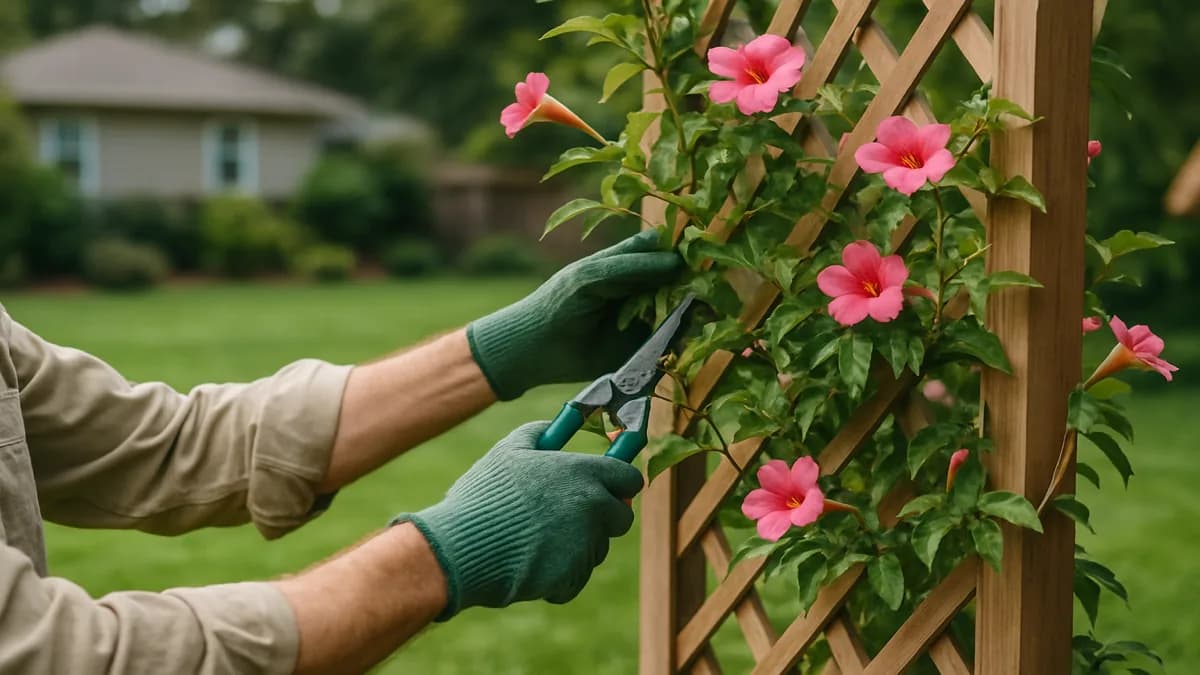
Not all flower vines are friendly. Here’s how to pick the right climbers for your yard, match them to supports, and dodge invasives and home damage.
On this page
- How Flower Vines Climb: Why It Changes Everything
- Best Flower Vines for Fences, Trellises, and Pergolas
- A Few Standouts
- Vines That Wreck Walls, Fences, or Your Weekend
- The Usual Offenders
- Honest Skip-It Scenario
- Where People Mess Up: Underbuilt Supports
- How to Plant and Support Flower Vines (Step by Step)
- Worked Example: Planting Clematis on a Fence
- What About Invasives and Local Rules?
- Mulch and Soil: Don’t Skimp
- Native vs. Non-Native: Why It Matters
- Quick Reference: Flower Vine Care
You’re here because you want flower vines,maybe for a fence, a pergola, or a little privacy. You’re probably picturing a wall of blooms, not a tangled mess or a vine ripping your siding off. Here’s what actually works, what to avoid, and how to keep your yard (and house) safe.
How Flower Vines Climb: Why It Changes Everything (opens in a new tab)
Flower vines aren’t all the same. They climb in four ways, and each method needs a different support. If you get this wrong, you’ll end up with a pile of dead stems or a vine glued to your paint.
Best Flower Vines for Fences, Trellises, and Pergolas (opens in a new tab)
Here’s what actually works in U.S. yards, sorted by climbing style and where they shine.
| Vine Name | Climbing Style | Best For | USDA Zones | Sun Needs | Invasive? | Notes |
|---|---|---|---|---|---|---|
| American wisteria | Twiner | Pergola, arbor | 5-9 | Full sun | No | Needs heavy support |
| Trumpet honeysuckle | Twiner | Fence, trellis | 4-9 | Sun-part sun | No | Hummingbird magnet |
| Clematis (group 3) | Tendril | Trellis, fence | 4-9 | Full-part sun | No | Prune hard in late winter |
| Climbing hydrangea | Clinger | Brick/stone wall | 4-8 | Shade-part sun | No | Heavy, slow to start |
| Star jasmine | Twiner | Fence, trellis | 8-10 | Sun-part sun | No | Evergreen in warm climates |
| Passionflower | Tendril | Fence, arbor | 6-10 | Full sun | No | Native, spreads by suckers |
| Climbing rose | Scrambler | Trellis, arbor | 5-9 | Full sun | No | Must be tied in |
| Boston ivy | Clinger | Brick wall | 4-8 | Any | No | Can damage wood/old mortar |
| Virginia creeper | Clinger | Brick, stone | 3-9 | Any | No | Native, great fall color |
A Few Standouts (opens in a new tab)
- Pergola? American wisteria or climbing roses (but only if you’re ready to tie and prune). Wisteria needs 4x4-inch (10x10 cm) posts or bigger.
- Fence or trellis? Trumpet honeysuckle, clematis, or star jasmine (in the South). Clematis needs thin wire or mesh.
- Shady wall? Climbing hydrangea, but only on solid brick or stone.
Vines That Wreck Walls, Fences, or Your Weekend (opens in a new tab)
Some vines look great for a year or two, then turn into a disaster. Here’s what to watch out for.
The Usual Offenders (opens in a new tab)
- English ivy: Invasive, damages wood, gutters, and even trees. Skip it.
- Japanese honeysuckle: Smothers native plants, banned in many states.
- Asian wisteria: Grows like kudzu, crushes arbors, and escapes into woods.
- Oriental bittersweet: Twines so hard it strangles trees.
- Trumpet vine: Native but can take over your yard and sprout everywhere.
| Vine | Main Problem | Safer Alternative |
|---|---|---|
| English ivy | Invasive, damages surfaces | Virginia creeper |
| Japanese honeysuckle | Invasive | Trumpet honeysuckle |
| Asian wisteria | Invasive, heavy | American wisteria |
| Oriental bittersweet | Invasive, tree killer | American bittersweet |
| Trumpet vine | Aggressive spreader | Trumpet honeysuckle |
Honest Skip-It Scenario (opens in a new tab)
If you want a vine you can plant and forget, skip anything that clings directly to your house or fence. Don’t even think about English ivy or Boston ivy unless you love scraping paint and fixing rot. Stick with twining or tendril vines on a separate trellis you can pull out if needed.
Where People Mess Up: Underbuilt Supports (opens in a new tab)
What usually happens is someone plants wisteria or a heavy rose on a cheap trellis or thin arbor. Two years in, the whole thing folds or leans. Or they plant a vine right against the wall, and it never gets enough water. Build supports for the full-grown weight. For wisteria, think 4x4-inch (10x10 cm) posts, not garden center lattice.
How to Plant and Support Flower Vines (Step by Step) (opens in a new tab)
Pick the right support for the vine
Twiners need posts or wires under 2 inches thick. Tendril vines want mesh or wire under 1/4 inch. Clingers go on solid brick or stone only. Scramblers must be tied in by hand.Install supports before planting
It’s a pain to add a trellis after the vine is in the ground. Put up your structure first.Space plants 12-18 inches from walls or fences
Soil right against a wall is usually dry and poor. Give roots room and angle the vine toward the support.Dig a hole twice as wide as the root ball
Mix in 2-3 inches of compost or aged manure. Vines are long-lived and need good soil to start strong.Water well, then mulch 2-3 inches deep
Keep mulch a few inches away from the stem to avoid rot. Mulch keeps roots cool and moist.Tie or train vines as they grow
Guide stems to the support. For roses, tie main canes horizontally for more blooms.
Worked Example: Planting Clematis on a Fence (opens in a new tab)
Let’s say you want to cover a 20-foot (6 m) section of fence with clematis. Clematis likes to be spaced 3 feet (90 cm) apart. You’ll need about 7 plants.
- Install wire or mesh (under 1/4 inch thick) along the fence.
- Dig holes 18 inches from the fence line.
- Amend each hole with 1 cubic foot of compost.
- Mulch 2 inches deep, but keep mulch 2 inches from stems.
- Water deeply after planting, then weekly until established.
- Prune according to clematis group (see table above).
What About Invasives and Local Rules? (opens in a new tab)
Just because a vine is for sale doesn’t mean it’s safe. Many big-box stores still sell Japanese honeysuckle, Asian wisteria, and English ivy,these are invasive in much of the U.S. Always check your state’s invasive plant list before buying. Your local extension office or rainwater harvesting guidelines by state page may have lists, too.
Mulch and Soil: Don’t Skimp (opens in a new tab)
Vines live a long time and need decent soil. Add 2-3 inches of compost or aged manure at planting. Mulch helps keep roots cool and moist, especially in hot or dry regions. For help figuring out how much mulch you need, try our mulch calculator.
Native vs. Non-Native: Why It Matters (opens in a new tab)
Native vines like trumpet honeysuckle, American wisteria, and Virginia creeper support local birds and pollinators. They’re less likely to escape and become a problem. Non-natives can look great but may cause headaches for you and your neighbors.
If you want privacy but don’t want to deal with vines, see 11 of the best privacy hedges. For structure ideas, check out our guide to pergolas. If you’re landscaping with stone, see flagstone ideas. And if you’re prepping for winter, don’t miss how to winterize a garden.
Quick Reference: Flower Vine Care (opens in a new tab)
- Prune: Most vines need annual pruning. Clematis needs it at the right time (see table above), wisteria twice a year. Skip pruning and you’ll get more leaves, fewer flowers.
- Water: Deeply after planting, then as needed. Established vines are drought-tough but need water in dry spells.
- Fertilizer: Go easy. Too much nitrogen = leaves, not flowers. Compost at planting is usually enough.
- Support: Build for the mature size and weight, not what you see in a 1-gallon pot.
Frequently asked questions
Calculators for this job
Plant Spacing Calculator
Find out how many plants a bed needs at your chosen spacing, and how many fewer you need if you offset the rows. Triangular spacing fits about 15% more plants into the same ground.
OpenSoil Calculator
Work out soil volume for any planting area, then see it costed as bags and as bulk. Handles rectangular beds, curved borders, circles, and irregular shapes built from sections.
OpenMulch Calculator
Enter your bed dimensions and how deep you want the mulch. You'll get cubic yards, the number of 2 cu ft bags, delivered weight, and whether bags or bulk works out cheaper at that volume.
OpenKeep reading
Privacy Plants That Work: Fast, Dense, and Right for Your Yard
Choosing privacy plants is about more than speed. Get real advice on spacing, climate fit, and which hedges actually work for small yards or tough spots.
6 min read
Pergola Types, Costs, and How to Avoid Regrets
Not all pergolas are the same. Get the facts on types, costs, and planning so you don’t waste money or end up with a sunburn trap.
7 min read
Winterizing Your Garden: What Actually Matters
Winter garden prep isn’t about wrapping everything in burlap. Here’s what actually matters for healthy beds, roses, and irrigation,plus what you can skip.
7 min read
Spotted something out of date or wrong? Tell us , we correct guides rather than leaving them to rot.