How to Actually Use Diatomaceous Earth to Treat Fleas
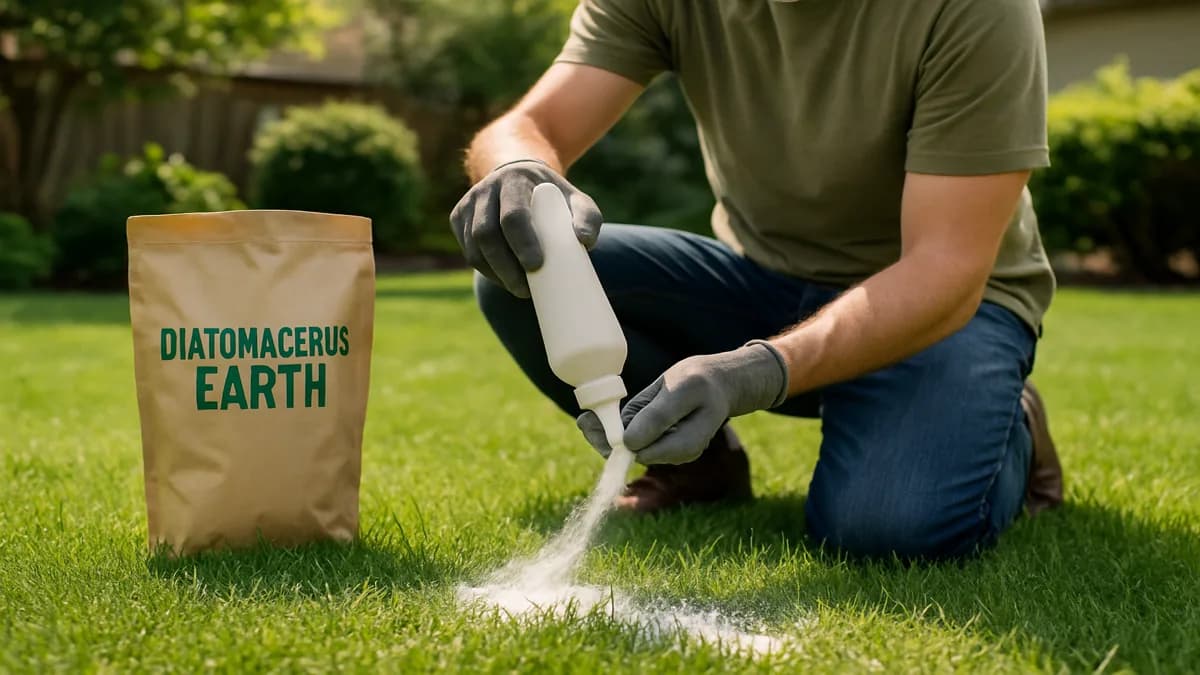
Diatomaceous earth can help control fleas if you use it right. Here’s how to apply it safely, where it works, and where people waste time.
On this page
- Does Diatomaceous Earth Work for Fleas?
- Food-Grade Only: Don’t Mess This Up
- Where DE Fits in Flea Control (and Where It Doesn’t)
- How to Apply Diatomaceous Earth for Fleas Indoors
- How to Use Diatomaceous Earth for Fleas Outside
- Skip-It Scenario: When DE Isn’t Worth Your Time
- Where People Mess Up With Diatomaceous Earth
- Comparing Flea Treatment Options
- Realistic Expectations: How DE Fits Into a Full Flea Plan
- Flea Identification vs. Lookalikes
- The Bottom Line
You’re probably here because you’ve got fleas,maybe you’ve tried sprays, maybe you’re hoping for something more natural. Diatomaceous earth (DE) can help, but only if you use it right. I’ll walk you through what actually works, what doesn’t, and how to avoid the usual mistakes.
Does Diatomaceous Earth Work for Fleas? (opens in a new tab)
Short answer: Yes, but only on adult fleas and only when it’s dry. Diatomaceous earth is a fine, chalky powder made from fossilized algae. Under a microscope, it looks like tiny shards of glass. When fleas crawl through it, those sharp edges scratch up their waxy coating. The flea dries out and dies,no chemicals involved.
Food-Grade Only: Don’t Mess This Up (opens in a new tab)
There are two types of diatomaceous earth you’ll see in stores:
| Type | Where You’ll See It | Safe for Home Use? | Notes |
|---|---|---|---|
| Food-grade | Garden/feed stores, online | Yes | What you want for fleas |
| Pool/filter-grade | Pool supply stores | No | Contains hazardous silica |
Where DE Fits in Flea Control (and Where It Doesn’t) (opens in a new tab)
Fleas have a sneaky life cycle. Here’s what you’re up against:
| Flea Stage | Where It Hides | Will DE Work? |
|---|---|---|
| Egg | Carpet, bedding, soil | No |
| Larva | Deep in fibers/soil | Sometimes, if exposed |
| Pupa | Sticky cocoon, hidden | No |
| Adult | On pets, in environment | Yes, if contact |
What usually happens is: You kill the adults and some larvae, but eggs and pupae survive. A week later, you see fleas again. That’s normal,keep repeating the process.
How to Apply Diatomaceous Earth for Fleas Indoors (opens in a new tab)
Here’s the real-world process I recommend. Don’t skip steps:
Vacuum First (and Often)
Vacuum all carpets, rugs, and pet hangouts. This pulls up a lot of eggs and larvae, and the vibration encourages pupae to hatch. Empty your vacuum outside right away.Wash Pet Bedding and Blankets
Toss all pet bedding, throws, and washable covers in the hottest wash cycle you’ve got. Hot water kills eggs and larvae.Apply a Thin Dusting of DE
Lightly sprinkle DE on carpets, rugs, baseboards, under furniture, and anywhere pets sleep. You want a barely visible layer,thick piles don’t work and just make a mess. Use a broom or brush to work it into the fibers.Let It Sit 24-48 Hours
Keep the area dry and undisturbed. Don’t let pets or kids in during this time.Vacuum Again
Vacuum up all the DE, dead fleas, and debris. Repeat this whole process every 3-4 days for at least 3-4 weeks.
Worked Example: Let’s say you have a 12x15 ft (180 sq ft) living room carpet and a 4x6 ft (24 sq ft) area rug in the bedroom. That’s 204 sq ft total. You’ll need about 1/2 to 1 pound (225-450 grams) of food-grade DE per application for this much area. A 4-lb bag (about $15-20) will last most households through a full month of treatments.
How to Use Diatomaceous Earth for Fleas Outside (opens in a new tab)
DE can help outside, but only in the right spots. Fleas don’t hang out in the middle of your sunny lawn,they hide in cool, shady, protected areas.
- Target: Under decks, porches, shrubs, along fence lines, and anywhere pets nap.
- Apply only when dry: Wait for a stretch of dry weather. DE is useless after rain, dew, or irrigation.
- Reapply after every rain or heavy dew.
- Don’t bother with open, sunny grass. Fleas rarely survive there.
Skip-It Scenario: When DE Isn’t Worth Your Time (opens in a new tab)
If you live somewhere humid (think Gulf Coast summers) or your yard stays damp, skip outdoor DE. It just turns to mush and does nothing. In these cases, focus on indoor treatment and talk to your vet about better outdoor options.
Where People Mess Up With Diatomaceous Earth (opens in a new tab)
- Using pool-grade DE. Dangerous and ineffective.
- Dumping on thick layers. Fleas avoid piles, and heavy dust is a health risk.
- Not repeating treatments. Flea eggs and pupae keep hatching for weeks.
- Applying to wet surfaces. Wet DE is useless.
- Putting DE on pets. Don’t do it.
Comparing Flea Treatment Options (opens in a new tab)
| Method | Pros | Cons | Best For |
|---|---|---|---|
| Food-grade DE | Natural, no chemicals | Slow, messy, must stay dry | Supplement to other methods |
| Vet-approved flea meds | Fast, proven, safe for pets | Cost, some require prescriptions | Treating pets directly |
| Vacuuming + hot washing | Removes eggs/larvae | Labor-intensive, must repeat | Indoors, all homes |
| Insect growth regulator (IGR) | Stops new fleas from maturing | Some are chemical-based | Persistent infestations |
| Outdoor sprays | Fast knockdown | Chemicals, may not last | Severe outdoor infestations |
Realistic Expectations: How DE Fits Into a Full Flea Plan (opens in a new tab)
Diatomaceous earth can help knock down flea numbers, but it’s never a solo solution. Here’s the full routine I give customers:
- Treat your pets with something that works. Ask your vet for a recommendation.
- Vacuum and wash bedding regularly. Every few days, not just once.
- Apply DE as described above, repeating for 3-4 weeks.
- Use an IGR spray if fleas keep coming back. These break the life cycle.
- Treat outdoor flea hotspots if your climate allows.
Flea Identification vs. Lookalikes (opens in a new tab)
| Pest | Size/Color | Jumps? | Where Found | DE Effective? |
|---|---|---|---|---|
| Flea | 1/16" (2 mm), reddish-brown | Yes | Pets, carpets, bedding | Yes (adults/larvae) |
| Carpet beetle | 1/8" (3 mm), black/brown | No | Baseboards, closets | Not really |
| Springtail | 1/16" (2 mm), gray/white | Yes | Damp soil, basements | No |
| Bed bug | 1/5" (5 mm), reddish | No | Mattresses, cracks | Sometimes |
If you’re not sure it’s fleas, check for tiny dark specks ("flea dirt") on pet bedding or use a flea comb. If you see bugs that don’t jump, you might have something else.
The Bottom Line (opens in a new tab)
Diatomaceous earth is a solid tool for natural flea control, but only if you use food-grade, keep it dry, and repeat treatments. It’s not a miracle cure,combine it with vacuuming, hot washing, and real flea meds for your pets. Skip outdoor use if your yard stays wet. If you’re still seeing fleas after a month, don’t be stubborn,try an IGR or call in a pro.
Looking for more on pest control or lawn care? Check out our guides on repairing mole damage, the difference between voles and moles, best shade garden plants, perennial ryegrass for lawns, and leaf cleanup tips.
Frequently asked questions
Calculators for this job
Keep reading
Vole vs Mole: Spot the Difference and Stop the Damage
Moles and voles leave very different clues,and fixing the problem depends on knowing which is which. Here’s how to tell, what to do, and what to skip.
8 min read
Fixing Mole Tunnels, Mounds, and Bare Spots in Your Lawn
Mole tunnels and mounds are ugly, but you can fix them. Learn how to level, reseed, and prevent future damage,without making it worse.
6 min read
Shade Garden Winners: Shrubs, Perennials, and Groundcovers That Work
Shade gardening is all about matching the right plant to the right spot. Here’s how to pick shrubs, perennials, and groundcovers that actually thrive in your yard’s shade.
6 min read
Spotted something out of date or wrong? Tell us , we correct guides rather than leaving them to rot.