How to Fix Dog Urine Spots on Your Lawn
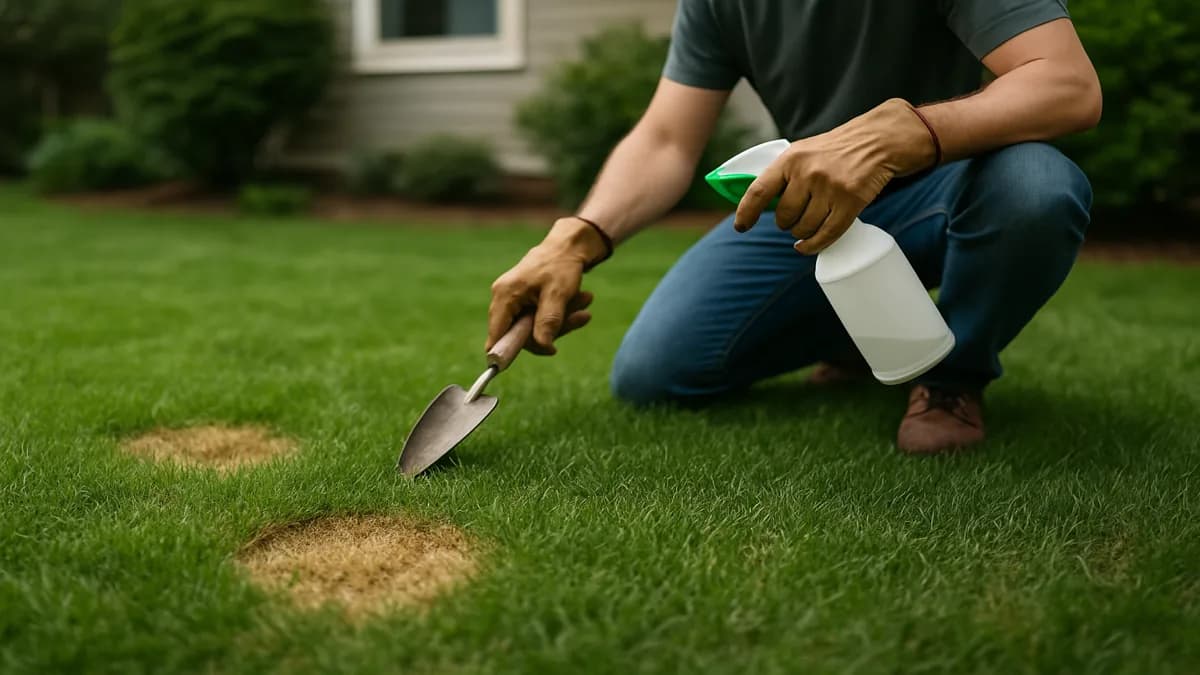
Dog urine can burn grass because of concentrated nitrogen and salts. Learn what the pattern means, how to repair spots, and which prevention myths to skip.
On this page
Dog urine spots on a lawn are usually nitrogen and salt burn. The classic pattern is a yellow or brown center with a dark green ring. Water fresh spots right away to dilute them, rake out dead grass once it is gone, then repair with seed or sod.
Assumptions for this guide: You have a US home lawn with one or more dogs using the yard; you are repairing turfgrass, not artificial turf; and you will follow seed, fertilizer, soil, and pet product labels. For dog diet or supplements, ask a veterinarian, not a lawn article.
Why Dog Urine Burns Grass (opens in a new tab)
Dog urine contains nitrogen and salts. In a small dose, nitrogen can green up grass. In a concentrated dose, it burns leaf tissue and roots. That is why many spots look strange: dead in the middle, greener around the edge.
The green ring does not mean the product you sprayed worked or the grass is diseased. It usually means the outer edge received a diluted nitrogen dose, while the center got too much at once.
| Lawn Pattern | Likely Cause | Quick Check | First Move |
|---|---|---|---|
| Brown center with dark green ring | Dog urine burn | Near favorite bathroom area | Flush fresh spots, patch dead centers |
| Random yellow patches with no ring | Water, disease, or insects | Check soil moisture and roots | Diagnose before treating |
| Stripes or arcs | Fertilizer overlap | Follows spreader path | Water deeply |
| Turf lifts like loose carpet | Grubs or root damage | Pull at patch edge | Inspect soil before reseeding |
| Raised tunnels plus bare areas | Moles or voles | Surface ridges or holes | Repair animal damage separately |
If you are unsure whether the spot is urine or something else, compare it with yellow grass causes and treatment. Pattern matters more than panic.
What to Do Right After It Happens (opens in a new tab)
Water is the best immediate fix. Pour enough water over the spot to dilute urine through the root zone. A watering can, hose, or quick sprinkler cycle all work.
This is not about drowning the whole lawn. It is spot dilution. If you start watering the entire yard every day, you can create shallow roots, fungus pressure, and soggy soil.
For normal lawn watering, use how often to water your lawn and adjust for rain, soil, shade, and grass type.
How to Tell If the Grass Is Dead (opens in a new tab)
Yellow grass may still recover. Brown, crispy grass that pulls away from the soil is usually dead. If the crown at the base of the plant is gone, waiting longer will not bring it back.
Wait a few days after flushing a fresh spot. If green growth returns, leave it alone and avoid extra fertilizer there. If the center keeps drying out and thinning, plan a patch repair.
| Spot Condition | Can It Recover? | What to Do |
|---|---|---|
| Pale yellow, blades still flexible | Often | Water deeply and wait 7-14 days |
| Brown center, green ring | Center usually no | Rake out dead grass and reseed |
| Bare soil after raking | No existing turf left | Add soil if needed, seed, and protect |
| Repeated spots in same path | Maybe, but weak | Create a dog bathroom zone |
| Many spots across the lawn | Mixed | Repair worst spots, prevent new ones |
Repairing Dog Urine Spots With Seed (opens in a new tab)
Seed repair works best when the grass type is actively growing. Cool-season lawns usually patch best in early fall or spring. Warm-season lawns repair best in late spring through summer when soil is warm.
Follow this basic repair:
- Rake out dead grass until you reach firm soil.
- Loosen the top half inch of soil.
- Add a small amount of topsoil if the spot is sunken.
- Seed at the label rate for bare spots.
- Press seed into the soil for contact.
- Keep the area lightly moist until germination.
- Delay mowing until new grass is tall enough for your mower setting.
Use how often to overseed a lawn if the damage is spread across a larger area instead of a few small circles.
Worked Example: Five Spots in a Backyard (opens in a new tab)
Say you have five dead dog urine spots. Each one is about 1 foot across. A 1-foot circle is about 0.8 sq ft, so five spots total about 4 sq ft of repair area. Round up to 5 sq ft because raking usually enlarges the edge.
If the grass seed label calls for 5 pounds per 1,000 sq ft for bare soil, the seed needed is 5 / 1,000 x 5 = 0.025 pounds. That is less than half an ounce. In real life, you will measure a small handful, not a big pour.
The topsoil amount is also small. For a 5 sq ft repair area with a 0.25-inch layer, you need about 0.1 cubic foot of soil. Buy the smallest bag that makes sense, then save the rest for future patching.
When Sod Makes More Sense (opens in a new tab)
Sod is better when you need instant cover, the dog keeps using the same area, or the spot is on a slope where seed washes away. Cut out the dead circle, square the edges, loosen the soil, and set a matching sod patch level with the surrounding lawn.
Water sod carefully until it roots. Keep dogs off the patch during establishment if possible. Fresh sod can be lifted, scratched, or soaked with new urine before it has a chance.
Prevention That Actually Helps (opens in a new tab)
The most reliable prevention is behavior and dilution, not miracle products. Train your dog to use a mulch, gravel, or pea gravel area. Rinse favorite pee spots when you see them. Rotate play and potty areas if the lawn is small.
Food and water habits can affect urine concentration, but do not experiment with salt, pills, or supplements because the lawn looks bad. That is a pet health decision. Bring diet questions to your vet, especially for puppies, senior dogs, or dogs with urinary, kidney, or heart concerns.
Female dogs get blamed more often because many squat and deposit urine in one concentrated spot. Male dogs can burn grass too, especially if they squat, mark the same small area, or use young turf.
| Prevention Method | Worth Trying? | Why |
|---|---|---|
| Water the spot right away | Yes | Dilutes nitrogen and salts before burn sets in |
| Train a potty zone | Yes | Keeps damage out of the main lawn |
| Use mulch or gravel in that zone | Yes | Easier to rinse and refresh |
| Give lawn supplements to the dog | Ask a vet first | Pet health comes before turf color |
| Add baking soda to spots | No | Can add salts and does not rebuild dead grass |
| Fertilize burned patches heavily | No | The problem is already too much nitrogen or salt |
If the rest of the lawn is hungry, follow a normal lawn fertilizer schedule and avoid extra fertilizer over green rings. Those rings are already getting a nitrogen boost.
When to Skip the Repair (opens in a new tab)
Skip repair during heat, drought, dormancy, or right before heavy dog use. Seedlings need steady moisture and protection. If your dog will keep running over the area tomorrow, wait or fence off the patch.
Skip seeding if the dead areas are actually tunnels, raised soil, or loose turf from animals. Use how to repair mole damage in your yard when the pattern points to digging or tunneling, not urine burn.
Common Mistakes (opens in a new tab)
The most common mistake is treating dog spots like a fertilizer deficiency. The green ring tells you the opposite: the spot already received a concentrated nutrient and salt dose. More fertilizer can make the burn worse.
Other mistakes include seeding over dead matted grass, watering the whole lawn daily instead of rinsing specific spots, changing a dog's diet without veterinary advice, and using seed during the wrong season for your grass type.
Do not expect any turfgrass to be urine-proof. Some lawns spread back into small spots faster than others, but repeated concentrated urine can damage any real grass.
Quick Repair Plan (opens in a new tab)
For fresh yellow spots, water immediately and wait. For dead brown spots, rake, loosen, patch, and protect. For repeat damage, change where the dog goes.
Use the lawn area calculator before buying repair material for a larger dog run or side yard. Small spots need less seed and soil than most people think, but repeated patches add up fast.
Frequently asked questions
Calculators for this job
Grass Seed Calculator
Seeding rates differ by species by a factor of twenty, bermudagrass wants 1 lb per 1,000 sq ft, perennial ryegrass wants 8. Pick your grass and whether you're starting fresh or overseeding.
OpenLawn Area Calculator
Almost every other lawn number depends on this one. Break your yard into simple shapes, subtract the parts that aren't grass, and get a square footage you can use for seed, fertilizer, and quotes.
OpenIrrigation Calculator
Find out how much water your lawn or garden actually needs each week, in both inches and gallons, and how to split it across the week for your soil type.
OpenTopsoil Calculator
Topsoil is heavy, roughly a ton per cubic yard, so knowing the weight matters as much as the volume. Enter your area and depth for yards, bags, and delivered tonnage.
OpenKeep reading
Yellow Grass in Your Lawn: What’s Wrong and How to Fix It
Yellow grass can be a quick fix or a sign of bigger trouble. Learn how to spot the difference, what to do first, and which mistakes to avoid.
8 min read
How Often Should You Water Your Lawn?
Most established lawns need about 1 to 1.5 inches of water per week including rain. Water deep and infrequent, not a little every day.
6 min read
How Often Should You Overseed a Lawn?
Overseeding isn’t a yearly chore for everyone. Here’s how to decide if, when, and how much to overseed,plus the steps that actually matter.
7 min read
Spotted something out of date or wrong? Tell us , we correct guides rather than leaving them to rot.