Gas Leaf Blower Bans: The Rules, the Map, and Your Options
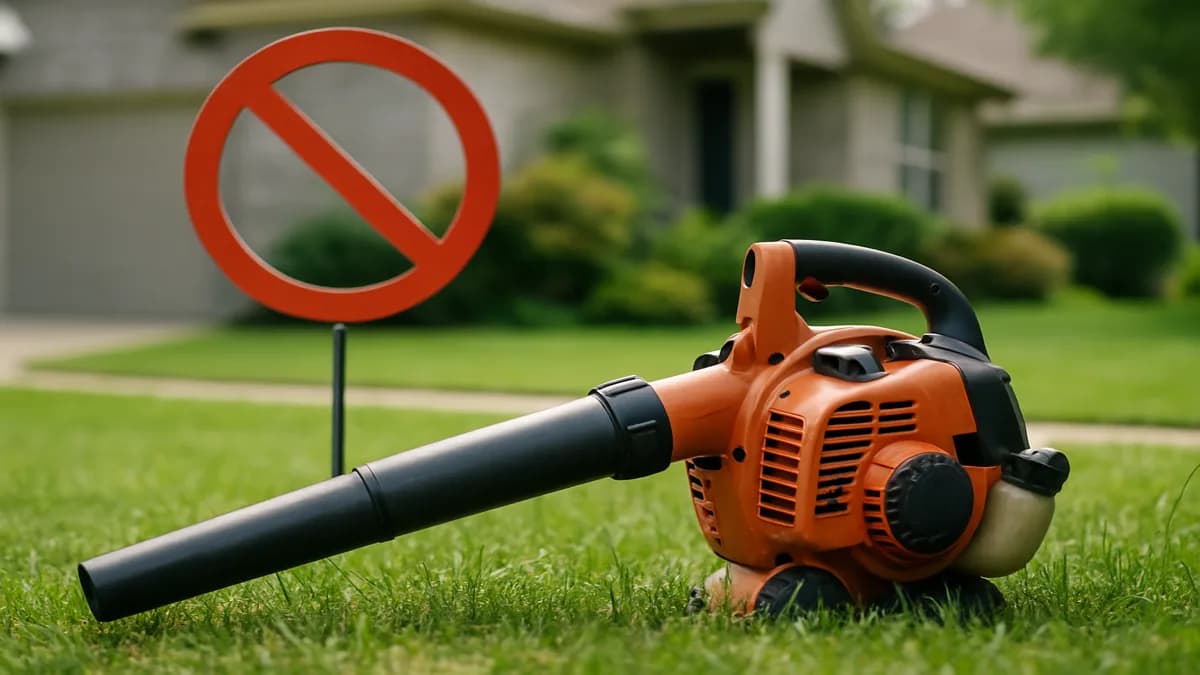
Gas leaf blower bans are spreading fast. Here’s how to check your local rules, what alternatives work, and the mistakes that get homeowners fined.
On this page
- Why Are Gas Leaf Blowers Getting Banned?
- What Kinds of Leaf Blower Restrictions Are Out There?
- Where Are Gas Leaf Blowers Banned or Restricted?
- How Do You Check Your Local Leaf Blower Rules?
- What Are the Alternatives to Gas Leaf Blowers?
- Battery-Powered Leaf Blowers
- Corded Electric Blowers
- Rakes and Tarps
- Mulch-Mowing
- Worked Example: Battery Blower vs. Gas Blower
- If You Hire a Lawn or Leaf Cleanup Service
- Skip-It Scenario: When You Don’t Need a Blower at All
- Where People Mess Up: Ignoring HOA or Neighbor Complaints
- Quick Reference: Gas vs. Electric Blower Rules
- More Resources
If you’re wondering whether you can fire up your gas leaf blower this weekend,or if your landscaper can,stop and check your local rules first. Gas leaf blower bans and restrictions are spreading fast, especially in California, the Northeast, and some Midwest cities. The rules aren’t always obvious, and the fines can sting.
Here’s what you need to know: Most bans target gas-powered blowers only. Battery and corded electric models are usually allowed, but some towns have noise or hour limits that apply to all types. If you’re in a city, suburb, or HOA neighborhood, don’t assume you’re in the clear just because you see others using blowers. What usually happens is enforcement ramps up after complaints, especially in fall.
Why Are Gas Leaf Blowers Getting Banned? (opens in a new tab)
The two big reasons: noise and pollution. Gas blowers,especially the old two-stroke kind,are loud, with a deep rumble that goes right through walls. That’s why you can hear them from a block away, even with your windows closed. The other issue is air quality. Two-stroke engines burn oil and gas together, sending out more smog-forming pollution per hour than most cars. California’s air board has been after these engines for years. Some towns also mention worker health, since crews are exposed to noise, fumes, and dust for hours.
What Kinds of Leaf Blower Restrictions Are Out There? (opens in a new tab)
There’s no one-size-fits-all rule. Here’s a quick look at the types of restrictions you might run into:
| Restriction Type | What It Means | Where You’ll See It |
|---|---|---|
| Full ban | No gas blowers, ever | DC, some CA & MA towns |
| Seasonal ban | No gas blowers during certain months (often summer) | Many Northeast towns |
| Hour limits | Only allowed during set hours (e.g., 9am-5pm) | Common in suburbs |
| Decibel cap | Only quiet models allowed (e.g., under 65 dB at 50 ft) | Some CA, NY, MA cities |
| Two-stroke ban | Only four-stroke engines allowed | Rare, but exists |
| Sales ban | Can’t buy new gas blowers, but can use old ones (for now) | California (statewide) |
| Phase-out | Ban announced, takes effect in a few years | Some cities, commercial focus |
Where Are Gas Leaf Blowers Banned or Restricted? (opens in a new tab)
The map changes every year, but here’s where bans and tough restrictions are in place as of 2024:
- California: Statewide ban on sales of new gas-powered leaf blowers and other small engines. Cities like Los Angeles, Santa Monica, Berkeley, and Palo Alto have had local bans or hour limits for years. Some towns allow use of old equipment for now, but not for long.
- Massachusetts: Dozens of Boston-area towns (Arlington, Cambridge, Brookline, Lexington, Belmont, Concord, and more) have seasonal or phased bans. Each town’s rules are different,some ban gas blowers all summer, others only allow them in fall.
- Washington, DC: Full ban on gas blowers since 2022. Battery and corded electric only.
- New York, New Jersey, Connecticut: Many towns in Westchester County, Long Island, and northern NJ have seasonal bans or strict hour limits. Some only allow battery or corded models.
- Illinois, Colorado, Oregon, Vermont, Florida: Scattered cities and towns with bans or restrictions. Chicago suburbs and Boulder, CO, have some of the stricter rules.
How Do You Check Your Local Leaf Blower Rules? (opens in a new tab)
Look up your city or town code
Most city and town websites have a searchable code or ordinance section. Try searching for “leaf blower,” “noise,” or “power equipment.”Check public works or environment pages
Many cities post a plain-English FAQ or summary, which is easier to read than the legal code.Ask your HOA or property manager
HOA rules can be stricter than city rules. Some ban all blowers, or limit hours even more.Talk to your landscaper
If you hire a crew, ask what equipment they use. In many towns, both you and the crew can be fined for violations.
What Are the Alternatives to Gas Leaf Blowers? (opens in a new tab)
If you can’t use a gas blower, you’ve got options. Here’s how they stack up:
| Method | Noise | Power | Typical Cost | Best For |
|---|---|---|---|---|
| Battery leaf blower | 60-70 dB | Good (for most yards) | $150-$400 (with battery) | Small-medium yards |
| Corded electric blower | 60-70 dB | Good (if near outlet) | $50-$120 | Small yards, near house |
| Rake & tarp | Silent | N/A | $20-$40 | Any yard, more work |
| Mulch-mowing | Low (mower) | N/A | Free (if you have a mulching mower) | Light-moderate leaf fall |
| Hire a service | Varies | Varies | $100-$300/season | Large yards, busy homeowners |
Battery-Powered Leaf Blowers (opens in a new tab)
Quieter, lighter, and no fumes. Most run 20-60 minutes per charge. For a typical quarter-acre lot, one or two batteries is usually enough. If you’ve got a big yard or lots of trees, you’ll want a spare battery or two. Brands like EGO, DeWalt, and Milwaukee make models that rival mid-range gas blowers for power.
Corded Electric Blowers (opens in a new tab)
Cheaper and unlimited runtime, but you’re stuck to the length of your extension cord. Good for small yards, patios, and close to the house. Not practical for big lots.
Rakes and Tarps (opens in a new tab)
Old school, but still works. For small yards, raking isn’t as slow as you’d think. A big tarp lets you drag piles to the curb or compost. No noise, no rules, no gas.
Mulch-Mowing (opens in a new tab)
If your leaf layer isn’t too thick (less than 1 inch deep), just mow over them with a mulching mower. The chopped leaves feed your lawn and save you the hassle of bagging. For more on this, see Best Ways to Clean Up Leaves in Your Yard.
Worked Example: Battery Blower vs. Gas Blower (opens in a new tab)
Say you’ve got a 5,000 sq. ft. yard with a big maple and a couple of oaks. In fall, you’ll spend 2-3 hours total on leaf cleanup. A good battery blower (EGO 56V, $250 with battery) will run about 35 minutes per charge. Two batteries covers your whole yard. You’ll spend $350-$400 up front, but no gas, oil, or tune-ups. Compare that to a mid-range gas blower ($200-$300), plus $20-$30/year in fuel and maintenance. If your town bans gas blowers, the battery model is the clear winner.
If You Hire a Lawn or Leaf Cleanup Service (opens in a new tab)
- Ask what tools they use. Some crews have switched to battery, but not all. In many towns, you’re liable if your crew breaks the rules.
- Expect some price difference. Battery gear costs more up front and may slow crews down a bit, but competition keeps prices reasonable. For a typical yard, expect $100-$300 per season for cleanup.
- Consider mulch-mowing. Ask if your crew can mulch leaves in place. It’s often cheaper and better for your lawn. For more, see guide to topdressing lawn grass.
Skip-It Scenario: When You Don’t Need a Blower at All (opens in a new tab)
If you have a small yard (under 2,000 sq. ft.) and only a few trees, skip the blower. A rake and a tarp will do the job in 20-30 minutes, and you won’t have to worry about noise or rules. Plus, you can use the leaves for compost or mulch. For composting tips, see corn gluten meal as natural weed and feed.
Where People Mess Up: Ignoring HOA or Neighbor Complaints (opens in a new tab)
The most common mistake I see is folks buying a new gas blower because the hardware store still sells them,then getting a warning or fine after a neighbor complains. Or, they hire a cheap crew that shows up with a noisy old gas blower, not realizing both the crew and the homeowner can be fined. Always check your rules and ask your crew before you get stuck with a ticket.
Quick Reference: Gas vs. Electric Blower Rules (opens in a new tab)
| Blower Type | Usually Allowed? | Typical Restrictions |
|---|---|---|
| Gas (2-stroke) | Often banned | Full/seasonal bans, decibel caps |
| Gas (4-stroke) | Sometimes allowed | Decibel caps, phase-outs |
| Battery electric | Usually allowed | Noise/hour limits in some towns |
| Corded electric | Usually allowed | Noise/hour limits in some towns |
| Rake/tarp | Always allowed | None |
More Resources (opens in a new tab)
Frequently asked questions
Calculators for this job
Keep reading
How to Clean Up Leaves Without Wrecking Your Lawn
Mulch-mowing leaves is usually best, but thick layers need removal. Here’s how to clean up leaves the right way for your lawn and climate.
7 min read

Topdressing Your Lawn: Real Advice for Healthier, Smoother Grass
Topdressing means spreading a thin layer of compost or soil over your lawn to fix bumps, improve soil, and help grass grow. The trick is never to bury the grass.
6 min read

Starter Fertilizer for New Grass: What Most Homeowners Get Wrong
Starter fertilizer can jumpstart new grass, but using it wrong wastes money or breaks the law. Here’s what to know before you spread.
6 min read
Spotted something out of date or wrong? Tell us , we correct guides rather than leaving them to rot.