How Much Does a Retaining Wall Cost?
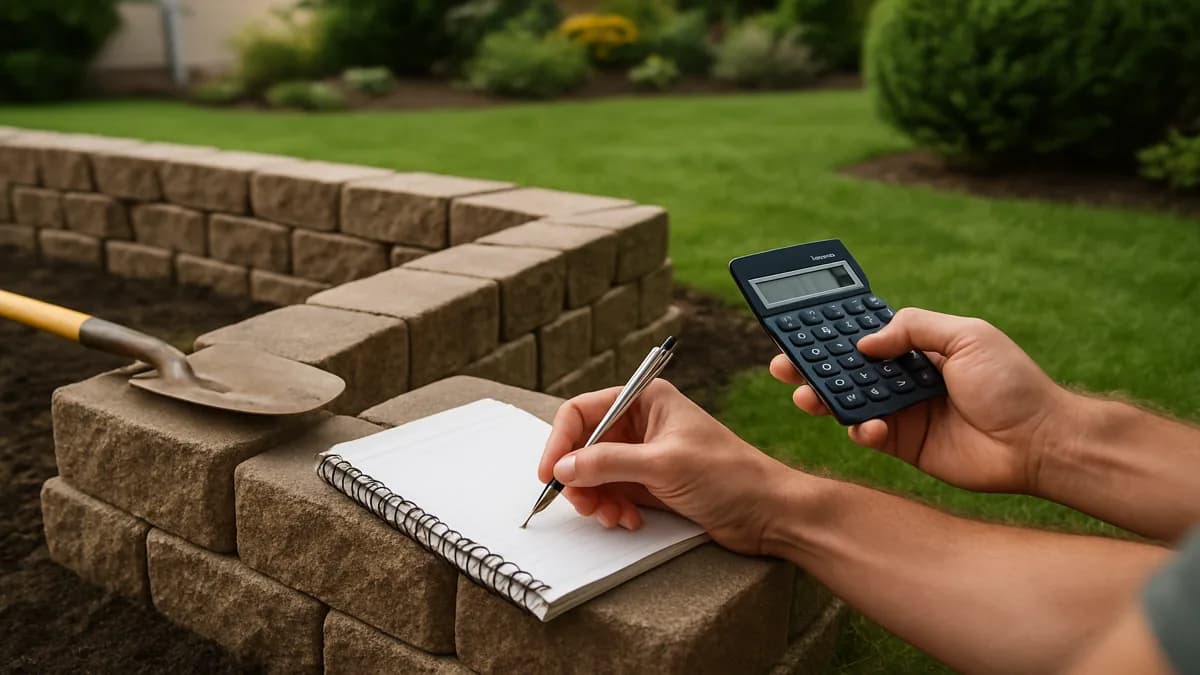
Retaining wall costs depend less on length than homeowners expect and more on height, drainage, backfill, access, and whether the wall is decorative or structural.
Every price here is a planning range, not a quote. Landscape pricing varies enormously by market, site access, and season, always get local bids before committing.
On this page
A retaining wall is priced by wall face area, material, drainage, access, and risk. Height is the big one. A low garden wall and a 5 foot wall holding up a driveway may use similar-looking blocks, but they are not the same project.
Cost by wall size (opens in a new tab)
Retaining wall area is length times exposed height, not yard square footage. A 40 foot long wall that is 3 feet tall has 120 square feet of wall face.
| Wall size | Wall face area | Installed planning range | Assumptions |
|---|---|---|---|
| 20 ft long by 1.5 ft tall | 30 sq ft | $750 to $2,400 | Low garden wall, easy access |
| 30 ft long by 2 ft tall | 60 sq ft | $1,500 to $4,800 | Small landscape wall |
| 40 ft long by 3 ft tall | 120 sq ft | $3,000 to $9,600 | Common block or timber wall |
| 50 ft long by 4 ft tall | 200 sq ft | $5,000 to $16,000 | Drainage and permits more likely |
| 60 ft long by 5 ft tall | 300 sq ft | $12,000 to $30,000+ | Structural design likely |
Small walls can price high per square foot because mobilization, layout, base excavation, and delivery do not shrink neatly with the wall. Tall walls can blow past the table because pressure, drainage, and liability rise together.
Cost by material (opens in a new tab)
Material choice matters, but it does not override height and drainage. A cheap wall built badly is expensive twice: once to install and again to remove after it leans.
| Wall type | Installed planning range | Best use | Watch for |
|---|---|---|---|
| Pressure-treated timber | $20 to $50 per sq ft of face | Short garden walls, budget projects | Shorter life, rot, tieback needs |
| Concrete landscape block | $30 to $75 per sq ft | DIY-friendly walls under code limits | Base prep and setback matter |
| Segmental retaining wall block | $40 to $90 per sq ft | Taller landscape walls with geogrid | Often needs design specs |
| Natural stone | $45 to $110 per sq ft | Visible garden walls and premium landscapes | Skilled labor and stone sorting |
| Poured concrete | $60 to $120+ per sq ft | Structural walls, tight footprints | Forms, steel, engineering |
Pressure-treated timber is often cheapest up front, but its lifespan is limited in wet soil. Concrete blocks cost more but are predictable and easier for homeowners to build correctly. Natural stone is beautiful near patios and planting beds, but fitting stone is slow skilled work. If the wall is part of a larger outdoor space, compare material choices with the broader landscaping cost guide.
Height changes everything (opens in a new tab)
Height is where retaining walls stop being landscaping and start being engineering. Soil does not push like a stack of books. As height increases, pressure rises fast, and water behind the wall makes it worse.
| Wall height | Typical approach | DIY risk |
|---|---|---|
| Under 18 inches | Decorative or light retaining | Low if drainage is simple |
| 18 to 30 inches | Small landscape wall with proper base and backfill | Reasonable for careful DIY |
| 30 to 48 inches | Real retaining wall, drainage required | Moderate to high |
| Around 4 ft and above | Permit or engineering often required | Hire out unless you have design support |
| Any height near structures | Treat as structural | Hire a pro |
Local codes vary, but many jurisdictions pay close attention around 4 feet of retained height. Do not use that as a magic safety line. A 3 foot wall holding back a driveway, pool deck, steep slope, or saturated clay can be more serious than a taller wall in open, dry soil.
Drainage and backfill costs (opens in a new tab)
Drainage is not optional. Water trapped behind a retaining wall adds pressure, pushes fines into the base, freezes in cold climates, and turns a good wall into a leaning wall.
| Drainage item | Planning range | Why it matters |
|---|---|---|
| Crushed drainage stone | $35 to $90 per ton | Lets water move down and out |
| Perforated drain pipe | $1 to $4 per linear ft | Collects water at the base |
| Filter fabric | $0.20 to $0.70 per sq ft | Keeps soil from clogging stone |
| Drain outlet or daylight point | Varies by site | Water needs somewhere legal to go |
| Extra excavation | $10 to $40+ per linear ft | Creates room for base and backfill |
The drain pipe should slope to daylight or a proper outlet. Backfill should be free-draining stone near the wall, compacted in lifts. Native clay against block is a common failure recipe.
DIY material costs (opens in a new tab)
DIY retaining wall materials look simple on a receipt: blocks or timbers, gravel, fabric, pipe, spikes or pins, and caps. The labor behind that receipt is excavation, leveling, compacting, hauling stone, checking batter, and making water leave the site.
| DIY item | Planning range | Notes |
|---|---|---|
| Landscape wall block | $3 to $9 per block | Coverage varies by block size |
| Cap block | $3 to $10 each | Often forgotten in early budgets |
| Pressure-treated timber | $15 to $45 per 6 by 6 timber | Regional lumber prices vary |
| Base gravel | $35 to $90 per ton | Compactable aggregate |
| Drainage gravel | $35 to $90 per ton | Clean crushed stone |
| Drain pipe and fittings | $1 to $5 per linear ft | Include outlets and fittings |
| Adhesive, pins, spikes | $25 to $100+ | Depends on wall system |
| Plate compactor rental | $75 to $150 per day | Needed for base and backfill |
For short walls, DIY materials may land around one-third to one-half of an installed quote. The savings are real, but wet soil, roots, boulders, narrow access, and disposal can erase the easy version of the project.
Worked example (opens in a new tab)
Take a 36 foot long block retaining wall that averages 30 inches tall. That is 90 square feet of wall face. The site has normal access, firm soil, and room behind the wall for a 12 inch drainage zone.
Using a $30 to $75 installed planning range for a concrete block wall, the project lands around $2,700 to $6,750. DIY materials might include block and caps, 3 to 5 tons of base and drainage stone, fabric, perforated pipe, adhesive, delivery, and a compactor rental. A rough DIY material plan might sit around $1,200 to $2,800, depending on block choice and delivery.
Now change one assumption: the wall becomes 4 feet tall and supports a parking area above. The visible face area rises to 144 square feet, but that is not the real change. The wall may need engineering, geogrid, more excavation, deeper base work, and stricter drainage. That second wall belongs in a different budget conversation.
Timber vs block vs stone (opens in a new tab)
Timber is the budget choice for short, informal walls where eventual replacement is acceptable. It works in straight lines and rustic landscapes, but it is not the long-life option in wet soil.
Concrete block is the sensible middle for many homeowners. It is consistent, available, and made for step-back wall systems. The blocks still need a level compacted base, buried first course, clean backfill, and alignment. Blocks do not fix bad prep.
Natural stone is chosen for appearance and landscape fit. It pairs well with garden paths, patios, and dry-laid details, especially if you are already using stone in the yard. The trade-off is labor. The same design thinking shows up in landscaping with flagstone, where the stone is only part of the cost and fitting it cleanly takes time.
Poured concrete is for structural or space-constrained walls. It can hold serious loads in a narrow footprint, but forms, steel, concrete placement, waterproofing, and engineering make it a professional job. If your wall connects to a slab or hardscape, review the base and drainage thinking in the concrete patio cost guide.
DIY vs hiring out (opens in a new tab)
DIY is realistic for a short garden wall where failure means a crooked bed edge, not a damaged home. Keep it low, use a manufactured wall system, follow the block maker's instructions, and do not improvise the base depth.
Hire a pro when the wall is tall, wet, curved, near a structure, near a property line, carrying a driveway or patio, or required by code to be permitted. Also hire out if spoil disposal is major. Dirt expands when excavated, and a wall trench can create more waste than expected.
Skip it: when a wall is the wrong fix (opens in a new tab)
Skip a retaining wall if grading can solve the problem more safely. A shallow slope can often be softened, planted, or terraced with low beds instead of held by one expensive wall. For planting-bed projects, mulch quantity may matter more than wall structure, and the mulch calculator guide is a better planning tool.
Also pause if the wall is meant to hide an active drainage problem. A retaining wall does not make water disappear. It concentrates the problem behind a structure. Fix the water path first, then decide whether the wall is still needed.
Common mistakes (opens in a new tab)
- Building too tall without design help. Height changes soil pressure, drainage needs, and code exposure.
- Backfilling with clay. Clay traps water and pushes against the wall.
- Skipping the buried first course. The bottom block or timber needs to sit below grade so the wall cannot kick out.
- Compacting only at the end. Base and backfill should be compacted in lifts.
- Forgetting water outlets. Drain pipe that never reaches daylight is just a buried tube.
- Ignoring surcharge loads. Driveways, patios, sheds, pools, and steep slopes above the wall all add pressure.
- Treating caps as optional. Caps shed water, finish the wall, and add stability to many block systems.
How to compare retaining wall quotes (opens in a new tab)
Ask for wall length, exposed height, buried depth, material system, base thickness, drainage stone width, fabric, drain outlet, geogrid if needed, excavation and disposal, access assumptions, permits, and warranty terms. If one quote includes drainage and one does not, they are not competing quotes.
A good quote spends money where the homeowner cannot see it: base, backfill, compaction, drainage, and design. The face block is only the part you get to look at.
Frequently asked questions
Calculators for this job
Landscaping Cost Calculator
Pick a project, enter its size, and set your market. You'll get a DIY material cost and an installed cost range, with the drivers behind the spread spelled out.
OpenGravel Calculator
Gravel is ordered by the ton but measured by volume, so this calculator gives you both. Pick your stone, enter the area and depth, and you'll get cubic yards, tons, and a delivered cost range.
OpenPaver Calculator
Enter your patio or walkway size and paver dimensions to get the paver count plus every layer underneath, base depth by traffic type, bedding sand, joint sand, and edging.
OpenKeep reading

How Much Does Landscaping Cost?
Landscaping costs vary more by market and site access than by anything on a spec sheet. A full front-yard renovation commonly lands between $5,000 and $25,000, and the spread is mostly excavation, access, and disposal.
6 min read
How Much Does a Paver Walkway Cost?
Paver walkways run $15 to $34 per square foot installed, more per square foot than a patio because there is far more cutting and edging per unit of area.
5 min read
How Much Does a Concrete Patio Cost?
A plain broom-finished concrete patio runs $8 to $20 per square foot installed. Stamped and coloured roughly doubles that, and the finish choice matters less than the base and the control joints.
5 min read
Spotted something out of date or wrong? Tell us , we correct guides rather than leaving them to rot.