How Much Does a Concrete Patio Cost?
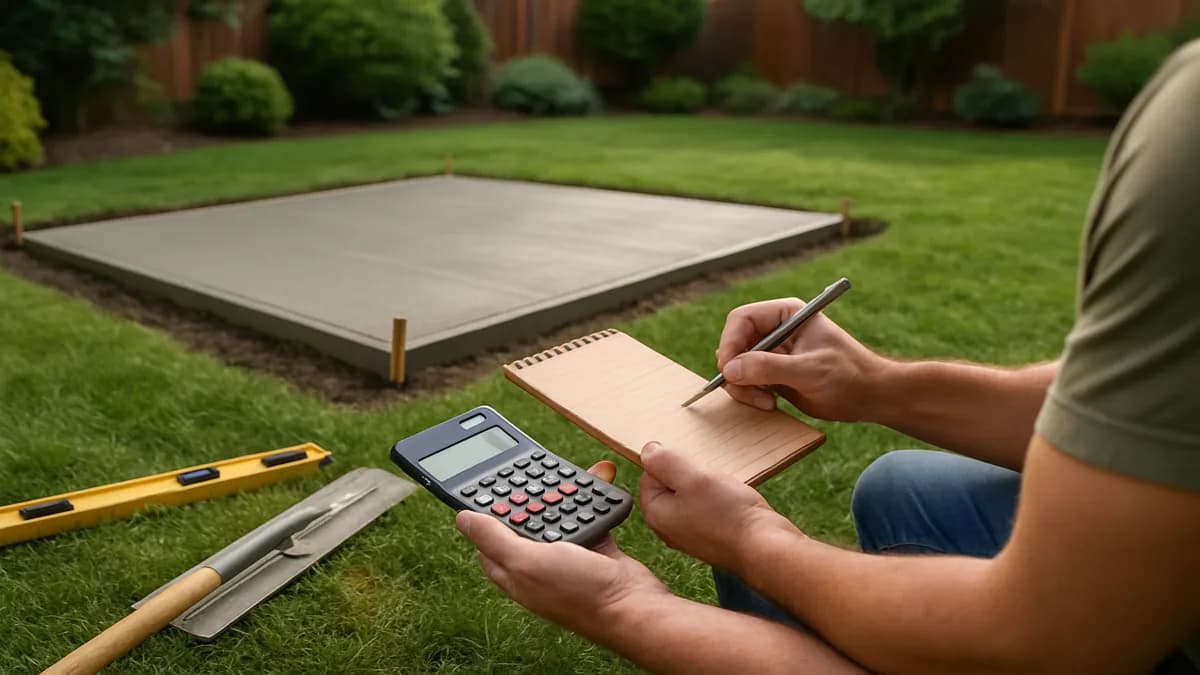
A plain broom-finished concrete patio runs $8 to $20 per square foot installed. Stamped and coloured roughly doubles that, and the finish choice matters less than the base and the control joints.
Every price here is a planning range, not a quote. Landscape pricing varies enormously by market, site access, and season, always get local bids before committing.
On this page
A concrete patio is a poured slab on a compacted base. Cost is driven far more by finish and by site conditions than by the concrete itself, which is a minor part of the total.
Cost by size and finish (opens in a new tab)
Average-cost market, 4-inch slab:
| Size | Plain | Coloured | Stamped |
|---|---|---|---|
| 10 × 10 ft (100 sq ft) | $800–2,000 | $1,200–2,500 | $1,500–3,000 |
| 12 × 16 ft (192 sq ft) | $1,540–3,840 | $2,300–4,800 | $2,880–5,760 |
| 16 × 20 ft (320 sq ft) | $2,560–6,400 | $3,840–8,000 | $4,800–9,600 |
| 20 × 20 ft (400 sq ft) | $3,200–8,000 | $4,800–10,000 | $6,000–12,000 |
Small slabs cost more per square foot. Most contractors apply a minimum job charge, and forming, delivery, and mobilisation are largely fixed regardless of area.
What you are paying for (opens in a new tab)
For a typical $14 per square foot plain patio, roughly:
| Component | Share |
|---|---|
| Concrete material | 25–35% |
| Labour: forming, placing, finishing | 40–50% |
| Excavation and base | 10–20% |
| Equipment, delivery, disposal | 5–15% |
Concrete commonly runs $140–220 per cubic yard delivered. A 400 sq ft patio at 4 inches needs about 5 cubic yards, so roughly $700–1,100 in material against a $3,200–8,000 total.
Finishes (opens in a new tab)
Broom finish is the default. A broom drawn across the surface after floating gives texture and slip resistance. Cheapest and entirely serviceable.
Exposed aggregate washes the surface paste away to reveal the stone. Durable, good grip, more interesting surface. Adds roughly $4–6 per sq ft.
Coloured uses integral colour mixed through, or a colour hardener broadcast on the surface. Integral costs more and lasts longer, since surface colour wears through eventually.
Stamped presses mats into wet concrete to imitate stone, brick, or slate. It doubles the cost of a plain slab because it doubles crew time and adds colour, release agent, and sealing.
Polished or acid-stained is usually applied to an existing slab, a resurfacing option rather than a new-pour finish.
Whether stamped is worth it (opens in a new tab)
Stamped concrete at $15–30 per square foot overlaps directly with pavers at $14–30. Worth weighing honestly:
- Stamped concrete needs resealing every two to three years to hold its colour. That is an ongoing cost and an ongoing job.
- A crack in a stamped slab is far more visible than a crack in a plain one, because it cuts across a pattern.
- Pavers at the same price do not crack, can be individually reset, and never need resealing.
The case for stamped is a seamless surface with no joints, and pattern options pavers do not offer.
Getting it built properly (opens in a new tab)
The finish is what people choose on. The base and the joints determine whether it is still good in fifteen years.
Excavate and compact the subgrade
Remove topsoil and organic material entirely: it decomposes and the slab settles into the void. Compact what remains.
Lay 4 inches of compacted gravel base
Provides drainage and a uniform bearing surface. Compact in lifts. Skipping this is the most common cause of premature failure.
Form and slope
About a quarter inch of fall per foot, away from the house. Establish this in the forms, not by trowelling later.
Place reinforcement correctly
Welded wire mesh or rebar on chairs, positioned in the middle of the slab depth. Mesh lying on the base does nothing, and it is a common shortcut.
Pour continuously
The whole slab in one placement. Stopping mid-pour creates a cold joint, a permanent plane of weakness that will crack along its line.
Cut control joints
Spacing roughly 24 to 30 times the slab thickness, so about 8 to 10 feet for a 4-inch slab, and a quarter of the depth. This decides where the slab cracks.
Cure it wet
Keep the surface damp for several days, or use a curing compound. Concrete gains strength through hydration, a chemical reaction with water. A slab that dries too fast is permanently weaker.
DIY (opens in a new tab)
For a small slab such as a shed pad, an AC pad, or a small landing, DIY concrete is realistic. For a full patio it is a demanding project.
The constraint is not skill with a trowel; it is time. Concrete has a working window measured in tens of minutes, and once the truck arrives the pour has to be placed, screeded, floated, and finished before it sets. That needs several people who know what they are doing, working continuously.
| Approach | When it makes sense |
|---|---|
| Bagged concrete, hand mixed | Under about 1 cubic yard |
| Ready-mix, DIY placement | 1–3 cubic yards with a crew of three or more |
| Hire the pour, DIY the prep | Genuine middle ground |
That last option is worth considering. Excavation, base preparation, and forming are unskilled, time-consuming work that contractors bill at skilled rates. Doing the prep and hiring the pour and finish can cut 20 to 30% off a quote.
Where it goes wrong (opens in a new tab)
- Base skipped or inadequate. The slab settles and cracks. Not repairable.
- Organic material left under the slab. Topsoil decomposes and the slab drops into the void.
- Mesh on the ground rather than mid-depth. Contributes nothing.
- No control joints, or spaced too far apart. Random cracking.
- Poured in extreme heat or near freezing. Both compromise curing. Cold weather work needs additives and protection.
- Water added on site to make placing easier. Every gallon past the mix design reduces final strength.
- Sealed too early. Traps moisture and can cause surface discoloration.
Frequently asked questions
Calculators for this job
Concrete Calculator
Get cubic yards and exact bag counts for slabs, footings, cylindrical piers, and stairs, plus whether mixing bags or ordering ready-mix makes sense at your volume.
OpenGravel Calculator
Gravel is ordered by the ton but measured by volume, so this calculator gives you both. Pick your stone, enter the area and depth, and you'll get cubic yards, tons, and a delivered cost range.
OpenLandscaping Cost Calculator
Pick a project, enter its size, and set your market. You'll get a DIY material cost and an installed cost range, with the drivers behind the spread spelled out.
OpenKeep reading
How Much Does a Patio Cost?
Patio cost per square foot ranges from about $4 for gravel to over $50 for premium stone. The cheapest to install is rarely cheapest over twenty years, and the gap narrows once repair is priced in.
5 min read
How Much Does a Concrete Sidewalk Cost?
Concrete walkways run $7 to $16 per square foot installed. Public-right-of-way sidewalks cost more because they must meet municipal specifications for thickness, slope, and accessibility.
5 min read
How Much Does a Paver Walkway Cost?
Paver walkways run $15 to $34 per square foot installed, more per square foot than a patio because there is far more cutting and edging per unit of area.
5 min read
Spotted something out of date or wrong? Tell us , we correct guides rather than leaving them to rot.