How Much Does Landscaping Cost?
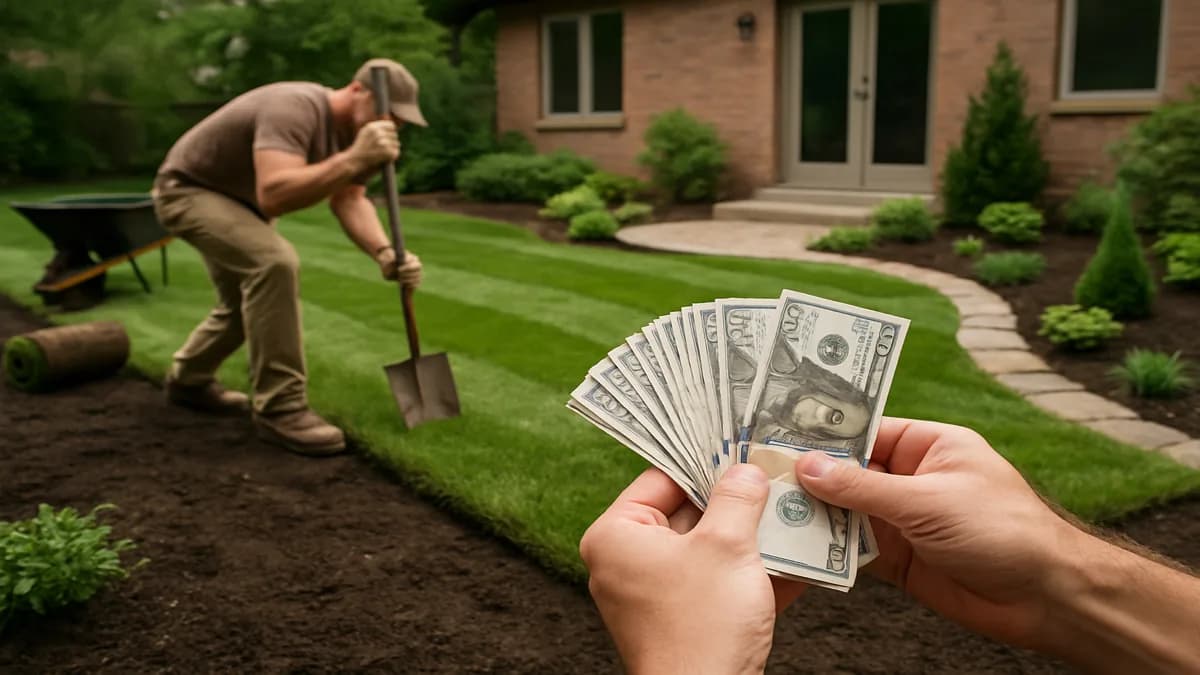
Landscaping costs vary more by market and site access than by anything on a spec sheet. A full front-yard renovation commonly lands between $5,000 and $25,000, and the spread is mostly excavation, access, and disposal.
Every price here is a planning range, not a quote. Landscape pricing varies enormously by market, site access, and season, always get local bids before committing.
On this page
Landscaping cost questions are hard to answer generically because the word covers everything from spreading mulch to building a retaining wall. What is consistent is the shape of the variation.
Installed cost ranges (opens in a new tab)
National-average market. Multiply by roughly 0.82 for lower-cost regions and 1.22 to 1.45 for high-cost metros.
| Project | Unit | Installed range |
|---|---|---|
| Paver patio | sq ft | $14–30 |
| Concrete patio | sq ft | $8–20 |
| Paver walkway | sq ft | $15–34 |
| Concrete sidewalk | sq ft | $7–16 |
| Sod installation | sq ft | $1.00–2.40 |
| Lawn seeding | sq ft | $0.12–0.35 |
| Hydroseeding | sq ft | $0.10–0.30 |
| Retaining wall | sq ft of wall face | $25–70 |
| Planting bed | sq ft | $8–22 |
| Landscape lighting | fixture | $150–450 |
| In-ground irrigation | zone | $500–1,100 |
| Fence | linear ft | $20–60 |
| Deck | sq ft | $30–85 |
| Pergola | sq ft of cover | $35–110 |
| Artificial turf | sq ft | $10–22 |
| French drain | linear ft | $25–70 |
| Tree planting | each | $200–900 |
What a whole-yard project costs (opens in a new tab)
| Scope | Typical range |
|---|---|
| Refresh: mulch, edging, some planting | $1,500–4,000 |
| Front yard: beds, planting, small walkway | $5,000–15,000 |
| Full front yard with hardscape | $15,000–35,000 |
| Back yard: patio, planting, lighting | $15,000–50,000 |
| Complete property including grading and drainage | $50,000+ |
These are wide because they should be. A 300 sq ft patio in standard concrete pavers with easy access is a different job from the same patio in tumbled stone behind a 36-inch gate on a slope.
The four things that actually move a quote (opens in a new tab)
Not the plants, and not usually the paver you pick.
Site access. The single largest hidden variable. A backyard reachable only through a narrow side gate means every ton of aggregate and every yard of spoil moves by wheelbarrow. That can add 30 to 50% to labour on a hardscape job, and it appears nowhere in the finished result.
Slope. Anything steep enough to need terracing, retaining, or step construction changes the job fundamentally. Grading and drainage on a slope routinely costs more than the visible landscaping on top of it.
Excavation and disposal. A 300 sq ft patio excavated 7 inches deep generates roughly 6.5 cubic yards of spoil, around 8 tons of soil that has to go somewhere. Dumpster hire and haul-away can run into four figures on its own.
Material tier. Standard concrete pavers and premium tumbled stone can differ threefold at identical square footage. Same labour, very different material line.
Design fees (opens in a new tab)
For anything substantial, a design is usually a separate line.
| Service | Typical cost |
|---|---|
| Consultation only | $75–250 |
| Basic plan for one area | $300–1,500 |
| Full property design | $1,500–5,000 |
| Landscape architect, complex site | $3,000–15,000+ |
Many design-build firms credit the design fee against installation if you use them to build. Worth asking before you commit.
A design is genuinely worth paying for on a large or difficult site, because drainage, grading, and circulation are the things people get wrong expensively. It is less necessary for a straightforward bed refresh.
DIY versus hiring out (opens in a new tab)
Material cost is typically 40 to 60% of an installed price. Where that gap is worth closing yourself depends on the job.
| Job | DIY verdict |
|---|---|
| Mulching beds | Do it. Simple, and labour is most of the cost |
| Planting shrubs and perennials | Do it. Low risk, high saving |
| Seeding a lawn | Do it. Modest materials, straightforward |
| Laying sod | Reasonable. Physical, and time-critical once delivered |
| Building a paver walkway | Reasonable. Rentable equipment, forgiving scale |
| Building a paver patio | Consider carefully. Base preparation is where it fails |
| Retaining wall over 3 ft | Hire. Structural, often needs engineering and a permit |
| In-ground irrigation | Hire. Backflow prevention, permits, zoning design |
| Grading and drainage | Hire. Getting this wrong damages the house |
| Tree removal | Hire. Genuinely dangerous |
Getting quotes that compare (opens in a new tab)
Get at least three for anything over a few thousand dollars
Two quotes tell you nothing about which is the outlier.
Write a scope before you call
Same square footage, same material, same intended use, given to every bidder. Without this you are comparing different jobs.
Ask for base depth in writing
For hardscape this is the number that predicts whether it stays flat. Four inches under a patio on clay is not enough, and it is invisible once laid.
Ask who handles spoil and debris
Included, or extra? On an excavated job this can be a four-figure difference.
Confirm permits and who pulls them
Retaining walls, irrigation connections, and electrical work commonly need them.
Check licensing and insurance
Ask for certificates rather than assurances. An uninsured crew on your property is your liability.
Be wary of a lowest bid that is far below the others
It usually means a thinner base, a cheaper material, or disposal excluded, not better value.
Phasing to spread the cost (opens in a new tab)
Large projects do not have to happen at once, and sequencing them well saves money.
Do first, always: grading and drainage, and any underground work such as irrigation lines, lighting conduit, and drainage runs. Retrofitting these under a finished patio means demolishing it.
Then: hardscape. Patios, walls, walkways. These define the structure everything else works around.
Then: planting. Lower cost, easier to change, and it can be staged across seasons.
Last: finishing. Lighting fixtures, furniture, containers, features.
Doing this out of order is the most common way people spend money twice.
Timing (opens in a new tab)
Cheapest: late autumn and winter, when crews have schedule gaps. Also horticulturally better for planting across most of the US.
Most expensive: spring, when everyone books at once and lead times stretch.
Materials: bulk material prices are seasonal in some markets, and end-of-season plant sales are real, though selection narrows and stock has often been sitting in pots all summer.
Frequently asked questions
Calculators for this job
Landscaping Cost Calculator
Pick a project, enter its size, and set your market. You'll get a DIY material cost and an installed cost range, with the drivers behind the spread spelled out.
OpenLawn Care Cost Calculator
Build a service plan and see what it costs per visit, per month, and per year. Mowing usually accounts for most of the total, and lawn size matters less than people expect.
OpenPaver Calculator
Enter your patio or walkway size and paver dimensions to get the paver count plus every layer underneath, base depth by traffic type, bedding sand, joint sand, and edging.
OpenKeep reading
How Much Does a Patio Cost?
Patio cost per square foot ranges from about $4 for gravel to over $50 for premium stone. The cheapest to install is rarely cheapest over twenty years, and the gap narrows once repair is priced in.
5 min read
How Much Does a Paver Walkway Cost?
Paver walkways run $15 to $34 per square foot installed, more per square foot than a patio because there is far more cutting and edging per unit of area.
5 min read
How Much Does Landscape Lighting Cost?
Landscape lighting runs $150 to $450 per fixture installed. The transformer, wire, and timer are a fixed cost regardless of fixture count, which is why small systems cost more per light.
5 min read
Spotted something out of date or wrong? Tell us , we correct guides rather than leaving them to rot.