How Much Does a Gravel Driveway Cost?
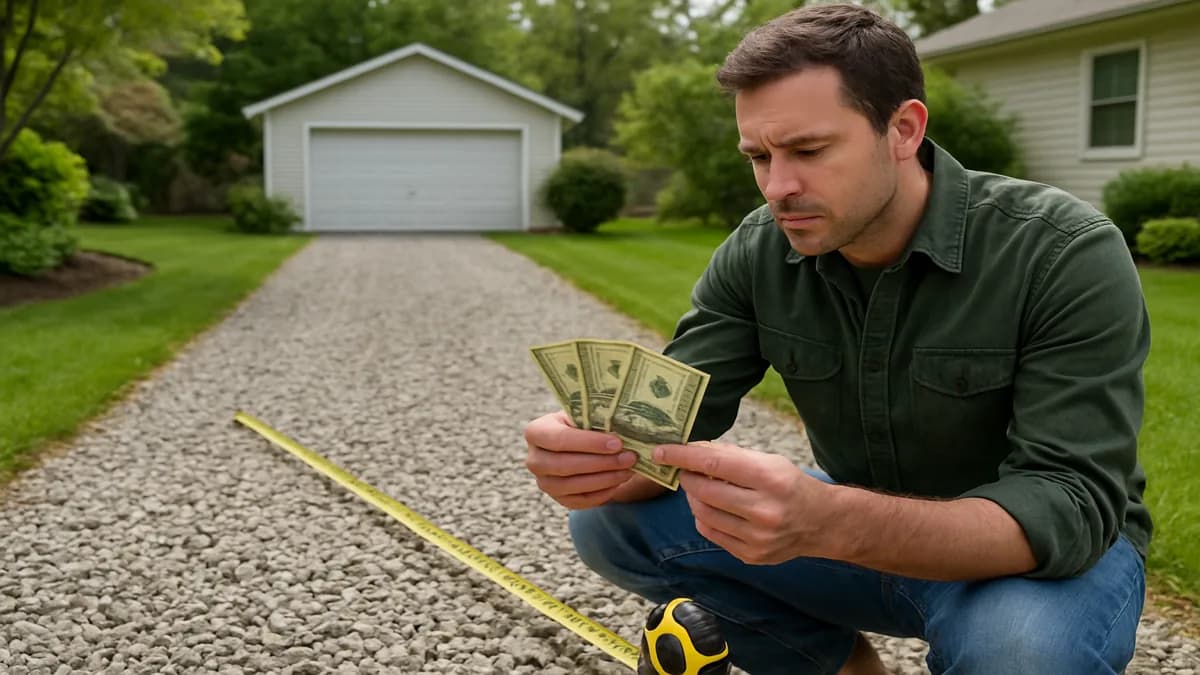
A gravel driveway is cheaper than concrete or pavers, but the final price depends on length, width, depth, base rock, surface stone, fabric, edging, and delivery access.
Every price here is a planning range, not a quote. Landscape pricing varies enormously by market, site access, and season, always get local bids before committing.
On this page
A gravel driveway usually costs less than concrete, asphalt, or pavers, but it is not just "a load of rock." The price is set by the driveway area, total depth, the base rock under the surface, fabric, edging, delivery distance, and how much grading is needed before any gravel arrives.
Cost by driveway size (opens in a new tab)
The table below assumes an average-access site, a compacted 4 to 6 inch base layer, a 2 inch surface layer, and locally available crushed stone. Narrow gates, steep slopes, long haul distances, or wet clay soil can move the job above these ranges.
| Driveway size | Area | DIY materials | Installed planning range |
|---|---|---|---|
| Single-car parking pad, 10 by 20 ft | 200 sq ft | $250 to $700 | $600 to $1,800 |
| One-car driveway, 10 by 40 ft | 400 sq ft | $500 to $1,400 | $1,200 to $3,600 |
| Two-car driveway, 20 by 40 ft | 800 sq ft | $1,000 to $2,800 | $2,400 to $7,200 |
| Long rural drive, 12 by 100 ft | 1,200 sq ft | $1,500 to $4,200 | $3,600 to $10,800 |
| Long rural drive, 12 by 250 ft | 3,000 sq ft | $3,750 to $10,500 | $9,000 to $27,000 |
Those ranges are wide because gravel is heavy and local. A quarry 8 miles away changes the math. A specialty stone hauled from another region changes it again. If you are comparing gravel against hardscape options, use the broader landscaping cost guide to see how driveways, patios, walls, beds, and drainage work fit into the same budget.
What drives the price (opens in a new tab)
Length and width set the square footage, but depth sets the tonnage. A driveway that looks only twice as big on the surface may need three times the stone if the soil is weak and the base has to be built deeper.
| Cost driver | Budget effect | What to ask |
|---|---|---|
| Length and width | More area means more tons, more grading, and more compaction passes | What exact dimensions are included? |
| Base depth | The base is usually the largest material volume | How many compacted inches of base rock? |
| Surface stone | Decorative stone costs more and may not lock together as well | Is this driveway stone or decorative gravel? |
| Geotextile fabric | Adds material and labor, but can keep soil from pumping into the base | What soil condition makes fabric useful here? |
| Edging | Keeps stone from spreading into lawn or beds | Is edging included or optional? |
| Delivery | Depends on distance, truck access, load minimums, and fuel | How many loads and what delivery fee? |
| Drainage | Ditches, crowns, culverts, and swales can exceed the gravel cost | Where does water go during a storm? |
Base rock and surface gravel are different jobs. The base needs angular, compactable stone, often crusher run or road base with fines, because it locks into a dense layer. The surface needs to shed water, resist tracking into the garage, and feel decent underfoot. A pretty round gravel that looks good in a garden bed can roll under tires and rut badly on a driveway.
DIY material costs (opens in a new tab)
For DIY planning, price by cubic yard or ton, then add delivery and equipment. Stone weight varies by material and moisture, so use the supplier's conversion when ordering. For rough planning, many crushed driveway stones land around 1.3 to 1.6 tons per cubic yard.
| Item | Planning range | Assumptions |
|---|---|---|
| Base rock or crusher run | $30 to $70 per ton | Local quarry product, not decorative stone |
| Surface gravel | $35 to $90 per ton | Angular driveway gravel, local supply |
| Geotextile fabric | $0.20 to $0.70 per sq ft | Material only, overlaps included |
| Plastic, steel, or timber edging | $2 to $8 per linear ft | Material only |
| Delivery | $75 to $250 per load | Varies by distance, load size, and access |
| Plate compactor rental | $75 to $150 per day | Small to medium DIY projects |
| Skid steer rental | $250 to $450 per day | Useful for larger grading jobs |
Installed costs (opens in a new tab)
Installed gravel driveways price by scope more than by stone alone. A simple top dress over an existing sound base might be a one-day job. A new driveway over soft soil needs excavation, fabric, base rock in lifts, compaction, crowning, and drainage planning.
| Installed scope | Planning range | Good fit |
|---|---|---|
| Top dress existing driveway | $1 to $3 per sq ft | Sound base, shallow ruts, no drainage issue |
| Rebuild surface and add base | $3 to $6 per sq ft | Typical worn driveway with moderate rutting |
| New gravel driveway | $4 to $9 per sq ft | New layout, grading, fabric, base, surface |
| Problem site with drainage | $8 to $15+ per sq ft | Wet soil, slope, culvert, ditch, or poor access |
For a 20 by 40 foot driveway, the difference between a refresh and a new build is the difference between spreading a few tons and building a compacted structure. This is why two quotes can disagree sharply and both be honest. One may be pricing a cosmetic top layer, the other a full base rebuild.
Worked example (opens in a new tab)
Say you want a 12 by 80 foot gravel driveway, 960 square feet. You plan for 4 inches of compacted base rock plus 2 inches of surface gravel, so 6 inches total. At 960 sq ft by 0.5 ft depth, that is 480 cubic feet, or about 17.8 cubic yards before compaction and waste.
If the supplier estimates 1.45 tons per cubic yard, the project needs about 26 tons total. At $45 per ton for base and $60 per ton for surface, plus two deliveries, fabric, and compactor rental, DIY materials and equipment might land around $1,800 to $3,200. A professional installation for the same driveway might plan around $3,800 to $8,600 depending on grading and drainage.
That is where the gravel calculator earns its keep. Change the depth from 4 inches to 8 inches and the tonnage doubles. Guessing by the truckload is how people end up short on stone or buried in a pile they cannot use.
Gravel vs concrete, pavers, and stone (opens in a new tab)
Gravel is the budget choice for long driveways, rural access, and homes where drainage and frost movement make rigid surfaces risky. It is not maintenance-free. It needs periodic raking, fresh top dressing, and edge cleanup.
Concrete costs much more up front, but a properly built slab gives a clean hard surface with less loose material. If your driveway project overlaps with a patio or parking slab, the concrete patio cost guide explains how base depth, forms, reinforcement, and finish affect concrete pricing.
Pavers and natural stone cost more still, but they fit walkways, entries, and decorative transitions better than a full driveway in many homes. Compare the labor and base requirements in the paver walkway cost guide and the design trade-offs in landscaping with flagstone before using a premium surface everywhere.
When DIY makes sense (opens in a new tab)
DIY makes sense for topping off an existing driveway, adding a small parking pad, or building a short, flat driveway where drainage already works. The labor is heavy but straightforward: measure, order, spread in layers, crown the surface slightly, compact thoroughly, and clean up the edges.
The best DIY savings come from doing the prep and letting a truck tailgate spread the stone. Many drivers can open the gate while moving slowly, leaving a rough layer that takes far less hand spreading. Ask before delivery day, because not every supplier or driver will do it.
Skip it: when gravel is the wrong driveway (opens in a new tab)
Skip gravel if the drive is steep enough that stone will wash downhill, if the entrance must stay spotless, or if snow removal is a constant winter chore and you cannot tolerate scraped gravel in the lawn. Also pause if water crosses the driveway during storms. Gravel can handle water beside it and under it. It performs poorly when water runs over it like a creek.
Gravel is also a poor choice where loose stone would create accessibility problems. Wheelchairs, walkers, narrow bicycle tires, and strollers all perform better on a firm, bound surface.
Common mistakes (opens in a new tab)
- Ordering one surface stone for the whole depth. A driveway needs a compactable base and a separate wearing surface.
- Ignoring the subgrade. Soft clay or wet soil needs drainage and a deeper base, not just more gravel on top.
- Skipping compaction. Loose stone settles under traffic and forms ruts quickly.
- Making the driveway flat. A slight crown or cross slope moves water off the surface.
- Using pea gravel on a slope. Rounded gravel shifts under tires and is hard to keep in place.
- Forgetting edging near beds. Gravel migrates into lawn and mulch unless the edges are contained. The same edge-control logic applies to planting beds, whether you use gravel or organic mulch.
How to compare quotes (opens in a new tab)
Ask each contractor for the driveway dimensions, excavation depth, base thickness, surface stone type, fabric spec, compaction method, drainage work, delivery count, and disposal plan. A quote that simply says "install gravel driveway" is not comparable to one that states layers and depths.
The cheapest quote is fine for a top dress over a sound base. For a new driveway, buy the base, the compaction, and the drainage first. The pretty top layer can always be refreshed later.
Frequently asked questions
Calculators for this job
Gravel Calculator
Gravel is ordered by the ton but measured by volume, so this calculator gives you both. Pick your stone, enter the area and depth, and you'll get cubic yards, tons, and a delivered cost range.
OpenLawn Area Calculator
Almost every other lawn number depends on this one. Break your yard into simple shapes, subtract the parts that aren't grass, and get a square footage you can use for seed, fertilizer, and quotes.
OpenLandscaping Cost Calculator
Pick a project, enter its size, and set your market. You'll get a DIY material cost and an installed cost range, with the drivers behind the spread spelled out.
OpenKeep reading
How Much Does Landscaping Cost?
Landscaping costs vary more by market and site access than by anything on a spec sheet. A full front-yard renovation commonly lands between $5,000 and $25,000, and the spread is mostly excavation, access, and disposal.
6 min read
How Much Does a Paver Walkway Cost?
Paver walkways run $15 to $34 per square foot installed, more per square foot than a patio because there is far more cutting and edging per unit of area.
5 min read
How Much Does a Concrete Patio Cost?
A plain broom-finished concrete patio runs $8 to $20 per square foot installed. Stamped and coloured roughly doubles that, and the finish choice matters less than the base and the control joints.
5 min read
Spotted something out of date or wrong? Tell us , we correct guides rather than leaving them to rot.