Grubs in Your Lawn: How to Confirm Damage and Treat It
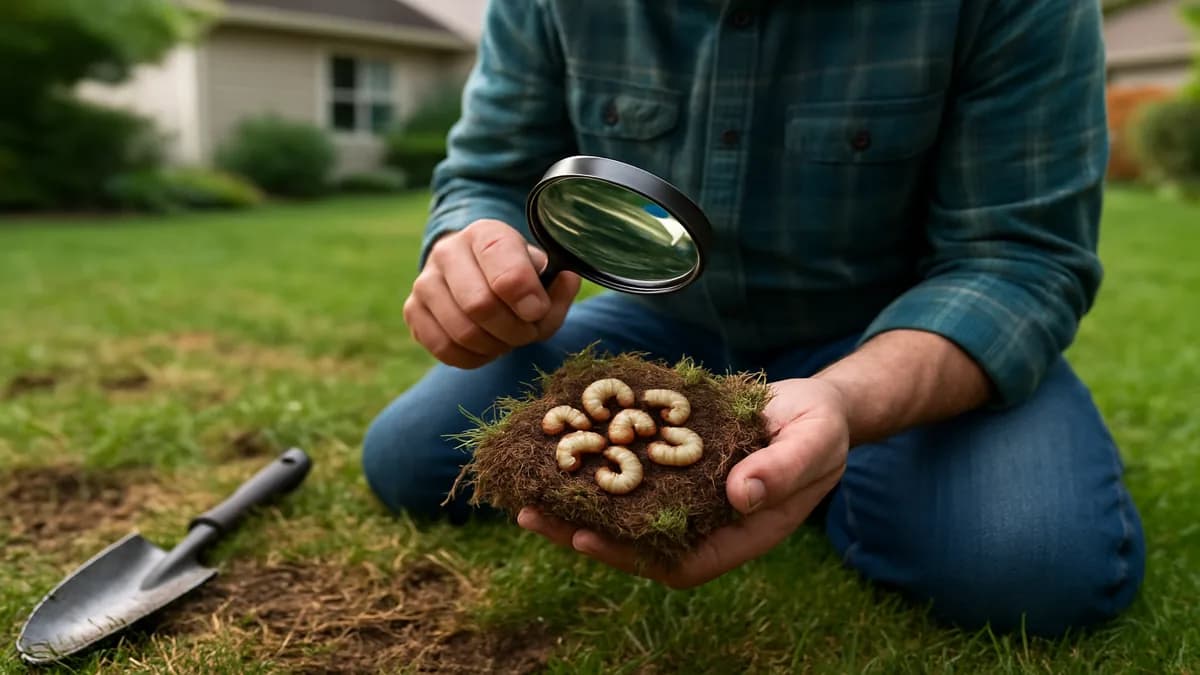
Brown patches that peel like carpet often mean grubs. Confirm the count before you buy a treatment, then time preventive or curative products correctly.
On this page
- What Lawn Grubs Actually Are
- Grub Damage vs Look-Alikes
- How to Confirm Grubs: The Square-Foot Dig
- Thresholds (rules of thumb)
- Preventive vs Curative Timing
- Treatment Steps That Actually Work
- Cultural Practices That Reduce Risk
- Worked Example: 5,000 Sq Ft Lawn With Two Hotspots
- Species Notes That Change Thresholds
- Repair Timeline After Curative Treatment
- Preventive Products and Pollinator Stewardship
- When to Call a Pro
- Mistakes That Waste Money
- Quick Reference Card
If a patch of lawn turns brown in midsummer and the turf peels up like a cheap carpet, white grubs are high on the suspect list. Birds, skunks, or raccoons tearing at the same spots are another clue. Still, drought, fungus, and dog urine can look similar from the driveway. Confirm the insects before you buy a jug of grub killer.
What Lawn Grubs Actually Are (opens in a new tab)
“White grub” is a group name for the larvae of scarab beetles such as Japanese beetles, masked chafers, and May/June beetles. They are creamy white, C-shaped, with a brown head and six small legs near the head. They feed on grass roots in the top few inches of soil.
Adult beetles fly and lay eggs in summer. Young grubs feed in late summer and fall, move deeper for winter in cold climates, then feed again in spring before pupating. That life cycle is why preventive products (aimed at tiny young grubs) and curative products (aimed at larger feeding grubs) are not interchangeable.
Authoritative overviews include University of Maryland Extension (opens in a new tab), Illinois Extension (opens in a new tab), and Clemson HGIC (opens in a new tab).
Grub Damage vs Look-Alikes (opens in a new tab)
Use this table before you spray. For a wider symptom tree covering urine, iron, and disease, see Yellow Grass: Causes and Fixes.
| Clue | Likely grubs | More likely something else |
|---|---|---|
| Turf lifts like carpet | Yes | Drought usually stays rooted |
| Irregular patches in sunny lawn | Common | Dog urine: small circles with green rings |
| Animals digging overnight | Possible | Moles can dig for worms too |
| Footprints stay pressed in grass | Can overlap | Classic drought stress sign |
| Mushrooms / dark rings after rain | Uncommon | Points more to fungal disease |
How to Confirm Grubs: The Square-Foot Dig (opens in a new tab)
Pick the damage edge
Sample where brown meets green. Grubs are often still active at the fringe.Cut one square foot
Go about 2 to 3 inches deep. Peel the sod back and shake soil from the roots.Count live grubs
Look for C-shaped larvae in the thatch and upper soil. Replace the flap and water it in.Repeat 2 to 3 spots
Grubs patch. One empty hole does not clear the lawn; one crowded hole does not prove the whole yard.
Thresholds (rules of thumb) (opens in a new tab)
Extension thresholds vary by species and irrigation:
- Many programs cite about 8 to 10 grubs per square foot for common species before chemical control is justified.
- Illinois Extension notes damage often around 12 per square foot, with healthy turf sometimes outgrowing lower counts.
- European chafer can justify lower thresholds in some northern regions.
When in doubt, treat documented hotspots, not imaginary whole-yard infestations.
Preventive vs Curative Timing (opens in a new tab)
| Approach | When it works | Typical products (examples of active ingredients) | Notes |
|---|---|---|---|
| Preventive | Late spring to midsummer, before or during egg hatch | chlorantraniliprole, imidacloprid (labels vary) | Needs water-in; best on lawns with history of damage |
| Curative | Late summer to early fall when damage appears | trichlorfon and other curatives on label | Larger grubs are harder to kill; act while they are near the surface |
| Cultural only | Any time counts are low | Deep watering, avoid chronic drought stress | Healthy roots tolerate more grubs |
Always follow the product label for rate, watering, and bee/pollinator precautions. Neonicotinoid products in particular have stewardship rules on many labels.
Treatment Steps That Actually Work (opens in a new tab)
- Confirm the count with digs. No insects, no insecticide.
- Choose preventive or curative based on season and grub size.
- Water the product in as the label requires so it reaches the root zone.
- Spot-treat damaged areas and a buffer when populations are patchy.
- Repair dead turf after control: rake out dead thatch mats, then overseed in the right window for your grass, or patch with sod.
If animals shredded the surface while hunting grubs, repair guidance overlaps with mole damage repair, even when moles were not the root cause.
Cultural Practices That Reduce Risk (opens in a new tab)
- Keep turf from chronic drought stress. Deep, infrequent watering helps roots outgrow light feeding. See how often to water your lawn.
- Avoid overfertilizing lush, irrigated Kentucky bluegrass stands if your neighborhood has a Japanese beetle problem. High-maintenance bluegrass is often hit harder than tough tall fescue.
- Do not expect killing grubs to “starve out” moles. Moles primarily eat earthworms.
Worked Example: 5,000 Sq Ft Lawn With Two Hotspots (opens in a new tab)
You peel two squares at the edge of brown patches and count 11 and 14 grubs. Mid-August. Plan:
- Buy a curative product labeled for white grubs on your grass type.
- Treat the damaged zones plus a 5 to 10 foot buffer, not necessarily the whole 5,000 sq ft if the rest samples clean.
- Water in immediately per label.
- Keep light irrigation on recovering edges.
- In early fall (cool-season), overseed bare spots after grub activity declines.
Species Notes That Change Thresholds (opens in a new tab)
Not every white grub is equally damaging per insect. Extension sheets often note that European chafer can justify lower action thresholds than Japanese beetle in some northern lawns, while green June beetle larvae behave differently and may be more visible on the surface at night. If you are identifying to species for a stubborn infestation, a 10x hand lens and the rasters (spine pattern on the grub’s rear) are the usual ID method in university fact sheets such as Clemson’s white grub guide.
For homeowners, the practical takeaway is simpler:
- Count first.
- Compare to a published threshold for your region.
- Treat hotspots when damage plus counts line up.
- Ask extension for species ID if you treat yearly and still lose turf.
Repair Timeline After Curative Treatment (opens in a new tab)
Week 0: Confirm counts, apply curative product, water in.
Week 1–2: Keep moisture steady on surviving edges. Dead centers will not revive.
Week 2–4: Rake out loose dead mats once grub feeding has stopped.
Cool-season fall window: Overseed or sod bare ground when temperatures favor establishment.
Warm-season lawns: Patch with sod or wait for the correct warm-season establishment window rather than forcing cool-season seed into a bermuda lawn.
Preventive Products and Pollinator Stewardship (opens in a new tab)
Many preventive grub materials are systemic insecticides. Labels increasingly include watering requirements, bloom restrictions, and pollinator precautions. Read the entire label, not just the rate chart. If flowering weeds are blooming in the lawn, mow them off before applications when the label requires it. Spot-treating documented problem zones is usually better stewardship than blanketing a clean acre.
When to Call a Pro (opens in a new tab)
Consider a licensed applicator if:
- Digs show high counts across most of a large property
- You cannot legally buy the product class recommended for your species
- Previous DIY treatments failed and resistance or misidentification is possible
- Wildlife digging is creating liability issues on slopes or near walkways
A pro should still sample. “Spray everything in June” is not IPM.
Mistakes That Waste Money (opens in a new tab)
- Treating brown drought patches with no dig test
- Applying preventive products in September and expecting overnight green-up
- Skipping the water-in step
- Reseeding the same week without checking pre-emergent herbicide history
- Annual whole-lawn preventive sprays with no history of damage
- Confusing mole tunnels with proof of economic grub thresholds
- Using leftover product from a prior year without checking storage stability and label
Quick Reference Card (opens in a new tab)
| Question | Short answer |
|---|---|
| Dig where? | Edge of damage |
| How deep? | About 2–3 inches |
| How many holes? | At least 2–3 |
| Typical action range | Often near 8–10+ per sq ft (species/region vary) |
| Preventive season | Late spring–midsummer |
| Curative season | Late summer–early fall |
| Repair | After control, in the right seeding window |
Grubs are a real pest with clear thresholds. Treat the count you verified, then rebuild the turf. Guessing from the porch is how empty bottles and still-brown lawns happen.
Frequently asked questions
Calculators for this job
Grass Seed Calculator
Seeding rates differ by species by a factor of twenty, bermudagrass wants 1 lb per 1,000 sq ft, perennial ryegrass wants 8. Pick your grass and whether you're starting fresh or overseeding.
OpenLawn Area Calculator
Almost every other lawn number depends on this one. Break your yard into simple shapes, subtract the parts that aren't grass, and get a square footage you can use for seed, fertilizer, and quotes.
OpenIrrigation Calculator
Find out how much water your lawn or garden actually needs each week, in both inches and gallons, and how to split it across the week for your soil type.
OpenKeep reading
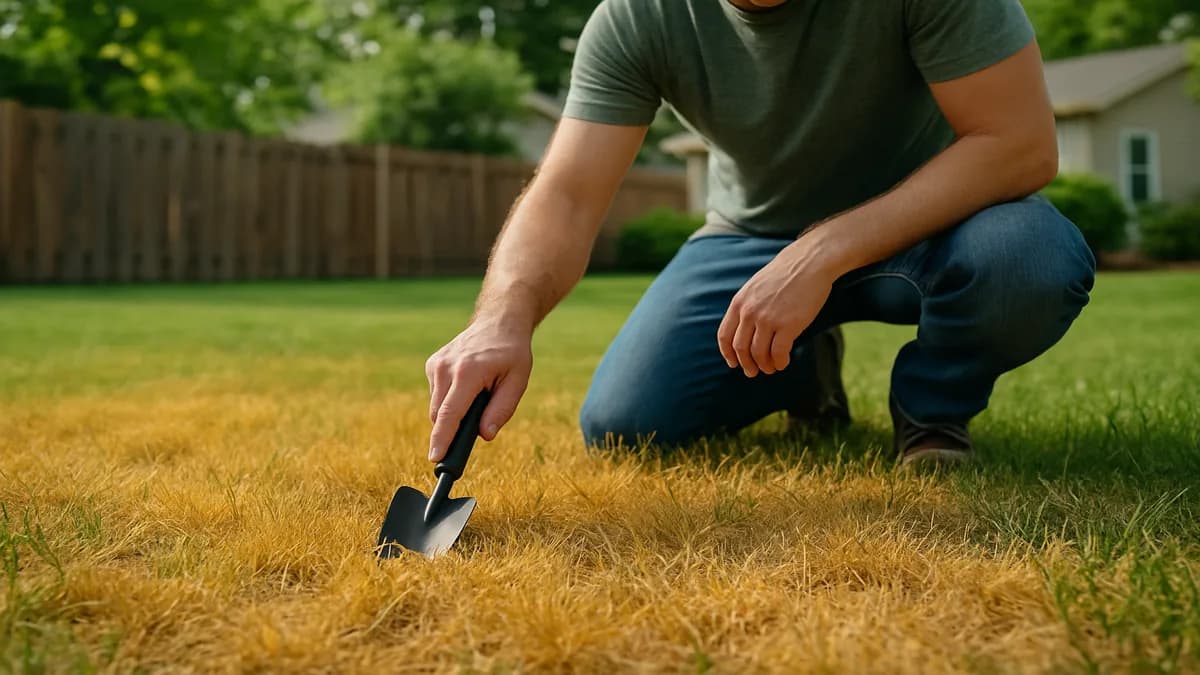
Yellow Grass in Your Lawn: What’s Wrong and How to Fix It
Yellow grass can be a quick fix or a sign of bigger trouble. Learn how to spot the difference, what to do first, and which mistakes to avoid.
8 min read
How Often Should You Overseed a Lawn?
Overseeding isn’t a yearly chore for everyone. Here’s how to decide if, when, and how much to overseed,plus the steps that actually matter.
7 min read
How Often Should You Water Your Lawn?
Most established lawns need about 1 to 1.5 inches of water per week including rain. Water deep and infrequent, not a little every day.
6 min read
Spotted something out of date or wrong? Tell us , we correct guides rather than leaving them to rot.