How Much Does Landscape Lighting Cost?
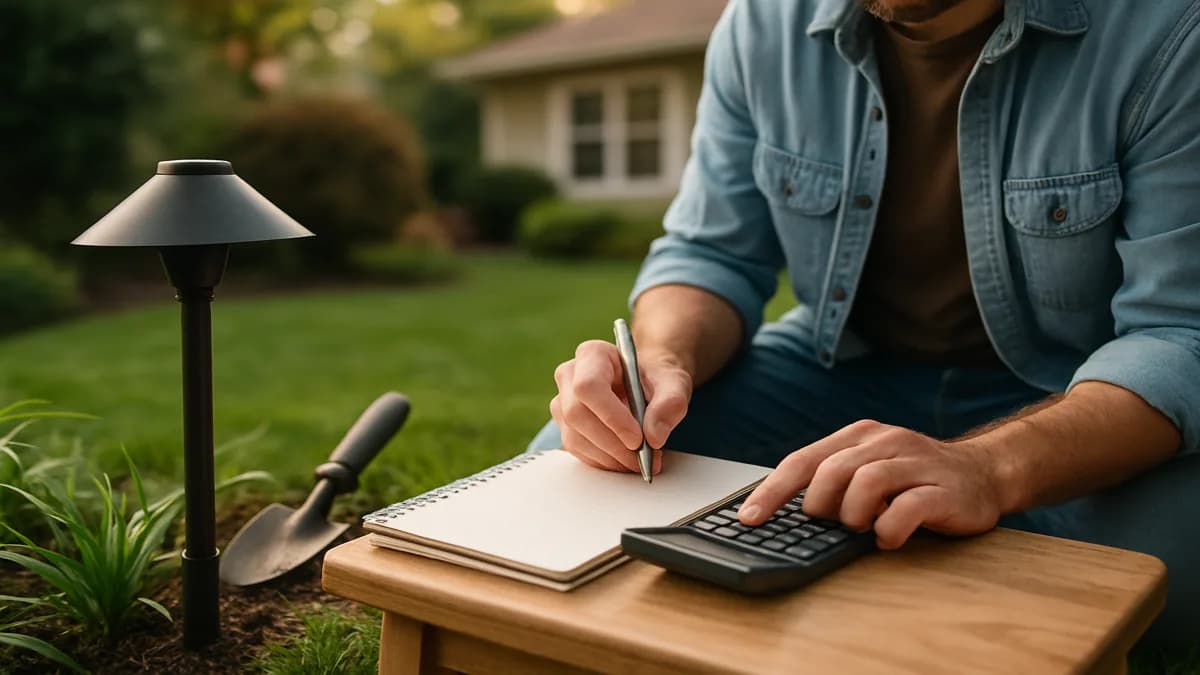
Landscape lighting runs $150 to $450 per fixture installed. The transformer, wire, and timer are a fixed cost regardless of fixture count, which is why small systems cost more per light.
Every price here is a planning range, not a quote. Landscape pricing varies enormously by market, site access, and season, always get local bids before committing.
On this page
Landscape lighting is priced per fixture, but a meaningful part of the cost is fixed regardless of how many lights you install.
Cost by system size (opens in a new tab)
| System | Fixtures | Installed cost |
|---|---|---|
| Entry and path only | 4–6 | $1,200–2,500 |
| Front of house | 8–12 | $2,000–4,500 |
| Whole property, typical | 15–20 | $3,000–8,000 |
| Large or complex property | 25–40 | $7,000–18,000 |
Minimum job charges around $1,200 are common, which is why a four-fixture install costs more per light than a twelve-fixture one.
Cost breakdown (opens in a new tab)
| Item | Typical cost |
|---|---|
| Path light | $45–150 each |
| Spot or accent light | $55–190 each |
| Well light (in-ground) | $70–220 each |
| Step or hardscape light | $50–160 each |
| Transformer, 150–300 W | $150–450 |
| Low-voltage cable | $0.60–1.60 per ft |
| Timer or photocell | $30–150 |
| Smart controller | $150–500 |
| Labour | $60–110 per hour |
Fixture quality is where the real difference lies. Cast brass and copper fixtures cost several times what die-cast aluminium does and last decades outdoors, developing a patina rather than corroding. Cheap fixtures at $15 to $25 typically fail within two to four seasons, and replacing them means the labour again.
Low voltage versus line voltage (opens in a new tab)
Low voltage (12 V)
Line voltage (120 V)
Standard for residential landscape lighting
Used for long runs and high-output floods
Safe to handle, cable buried shallow without conduit
Requires conduit, permits, and licensed work
DIY-installable in most jurisdictions
Electrician required in most jurisdictions
Needs a transformer
No transformer
Voltage drop limits run length
Minimal voltage drop over distance
Fixtures cost less
Fixtures and installation cost more
For almost all residential landscape lighting, low voltage is the correct answer. Line voltage makes sense for long driveway runs and high-output security lighting.
Sizing the transformer (opens in a new tab)
The one technical decision that catches DIY installers.
Total the wattage of all fixtures, then add roughly 20% headroom. A transformer running at capacity runs hot and shortens its own life, and the headroom leaves room to add fixtures later.
| Total fixture load | Transformer |
|---|---|
| Up to 60 W | 75 W |
| Up to 100 W | 150 W |
| Up to 240 W | 300 W |
| Over 240 W | 600 W, or multiple units |
Voltage drop is the other constraint. Low-voltage cable loses voltage over distance, and a fixture at the end of a long run receives less than 12 volts and dims noticeably.
Managing it:
- Use heavier gauge cable for long runs: 12 gauge rather than 16
- Split into multiple runs from the transformer rather than one long daisy chain
- Use a hub or T-method layout instead of a single line
- Many transformers offer multiple voltage taps (12 V, 13 V, 14 V) to compensate on longer runs
LED fixtures draw far less current than the halogen fixtures these rules were developed for, so voltage drop is much less limiting than it used to be.
DIY (opens in a new tab)
A low-voltage system is a genuinely realistic DIY project, with one caveat.
Material cost for a 12-fixture system:
| Item | Cost |
|---|---|
| 12 fixtures at $70 each | $840 |
| 300 W transformer | $250 |
| 200 ft of 12 gauge cable | $160 |
| Connectors and stakes | $60 |
| Timer or photocell | $60 |
| Total | $1,370 |
Against $2,400 to $5,400 installed. A saving of roughly $1,000 to $4,000 for a weekend's work.
Plan the layout in the dark
Walk the property at night with a torch and work out what you actually want lit. Most people over-light on the plan and under-light the things that matter.
Lay fixtures out before burying anything
Connect them temporarily on the surface and look at the effect after dark for a night or two. Moving a fixture is trivial now and tedious later.
Call 811 before trenching
Free, required in most of the US, and lighting cable runs cross irrigation and service lines routinely.
Bury cable 6 inches deep
Deep enough to avoid an edger or an aerator, shallow enough to be workable. Route along bed edges rather than across lawn where possible.
Use waterproof connectors
This is where cheap systems fail. Gel-filled or silicone-filled connectors, not twist caps.
Set the timer or fit a photocell
An astronomic timer that tracks sunset needs no seasonal adjustment.
Running cost (opens in a new tab)
LED has made this negligible.
A 20-fixture LED system at roughly 5 watts each draws about 100 watts. Running six hours a night for a year is about 220 kilowatt-hours, which at typical US residential rates is roughly $30 to $50 a year.
The same system in halogen at 20 watts per fixture would draw 400 watts and cost four times as much to run, plus regular bulb replacement. Any system still running halogen is worth converting on running cost alone.
Where to save (opens in a new tab)
Fewer, better fixtures. Twelve well-placed lights read better than twenty scattered ones, and cost less. Over-lighting is the most common design mistake and it flattens a garden rather than shaping it.
Buy quality fixtures, install them yourself. Fixture quality determines lifespan; installation is straightforward. This is the reverse of the usual advice and it is right here.
Start with a large transformer. The headroom costs little now and lets you add fixtures later without replacing it.
Phase it. Install the transformer and main runs, light the entry and path first, and add accent lighting over following seasons.
Skip the smart controller initially. A basic astronomic timer does the essential job. Smart control can be added later by swapping the timer.
Frequently asked questions
Calculators for this job
Landscaping Cost Calculator
Pick a project, enter its size, and set your market. You'll get a DIY material cost and an installed cost range, with the drivers behind the spread spelled out.
OpenPlant Spacing Calculator
Find out how many plants a bed needs at your chosen spacing, and how many fewer you need if you offset the rows. Triangular spacing fits about 15% more plants into the same ground.
OpenKeep reading

How Much Does Landscaping Cost?
Landscaping costs vary more by market and site access than by anything on a spec sheet. A full front-yard renovation commonly lands between $5,000 and $25,000, and the spread is mostly excavation, access, and disposal.
6 min read
Pergola Types, Costs, and How to Avoid Regrets
Not all pergolas are the same. Get the facts on types, costs, and planning so you don’t waste money or end up with a sunburn trap.
7 min read
Privacy Plants That Work: Fast, Dense, and Right for Your Yard
Choosing privacy plants is about more than speed. Get real advice on spacing, climate fit, and which hedges actually work for small yards or tough spots.
6 min read
Spotted something out of date or wrong? Tell us , we correct guides rather than leaving them to rot.