How Much Does a Septic System Cost?
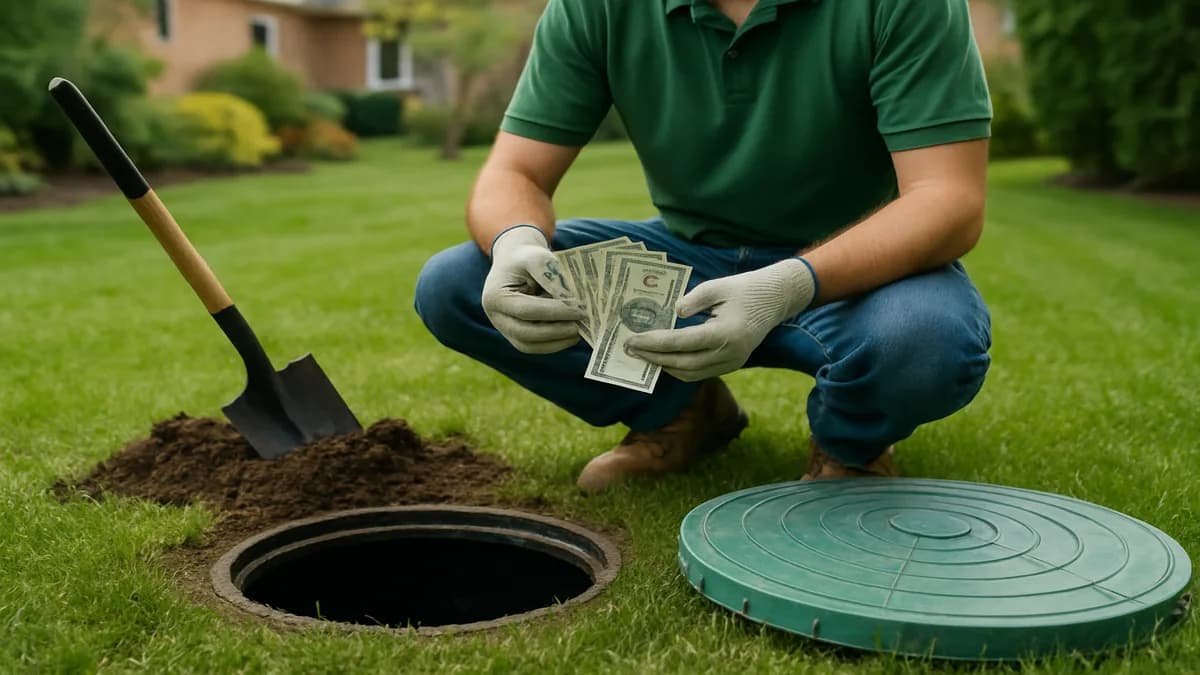
A conventional gravity septic system runs $7,000 to $15,000 installed. Mound and aerobic systems can double that, and the deciding factor is your soil, not your budget.
Every price here is a planning range, not a quote. Landscape pricing varies enormously by market, site access, and season, always get local bids before committing.
On this page
Septic system cost is decided by your soil before anyone quotes a price. A percolation test determines which system type your site can legally use, and that choice drives the total more than any other factor.
System types and what forces each one (opens in a new tab)
| System | Typical installed cost | When it is used |
|---|---|---|
| Conventional gravity | $7,000–15,000 | Good percolation, deep water table, adequate space |
| Pressure distribution | $10,000–20,000 | Adequate soil but sloped or irregular drain field |
| Chamber system | $8,000–17,000 | Alternative to gravel trenches, smaller footprint |
| Mound system | $15,000–30,000 | Shallow soil, high water table, or poor percolation |
| Aerobic treatment unit | $12,000–30,000 | Poor soil, small lots, sensitive environments |
| Sand filter | $12,000–25,000 | Poor soil, higher treatment requirement |
| Drip distribution | $12,000–25,000 | Shallow soil, irregular sites |
A mound system builds an artificial elevated drain field above the natural soil. It is used where the native soil cannot accept effluent at depth, and it is expensive because you are constructing the treatment medium rather than using what is there.
An aerobic treatment unit injects air to accelerate breakdown, producing cleaner effluent that can be dispersed in a smaller area. It needs electricity, ongoing servicing, and in many jurisdictions a mandatory maintenance contract.
Cost breakdown (opens in a new tab)
For a conventional system:
| Component | Typical cost |
|---|---|
| Percolation test and soil evaluation | $450–1,500 |
| System design | $500–2,000 |
| Permits | $300–1,500 |
| Septic tank, 1,000–1,500 gal | $900–3,000 |
| Excavation | $1,200–4,500 |
| Drain field materials and installation | $2,500–7,000 |
| Pipe, fittings, distribution box | $400–1,200 |
| Backfill and site restoration | $500–2,000 |
| Inspection | $150–500 |
The tank people focus on is typically 10 to 20% of the total.
Tank material (opens in a new tab)
| Material | Cost | Notes |
|---|---|---|
| Concrete | $900–2,500 | Most common, very durable, heavy to place |
| Fiberglass | $1,200–2,500 | Lighter, will not corrode, can shift in wet ground |
| Plastic (polyethylene) | $1,000–2,500 | Lightest, easiest access, less structural strength |
Tank size follows bedroom count in most jurisdictions, commonly 1,000 gallons for three bedrooms and 1,250 to 1,500 for four or five. Local code sets the requirement.
The percolation test (opens in a new tab)
This is the step that determines everything, and it happens before any meaningful quote.
A licensed evaluator digs test holes, examines the soil profile, and measures how quickly water drains. The results establish:
- Whether a conventional drain field is permitted at all
- How large the drain field must be
- How deep it can be placed
- Whether an engineered alternative is required
Costs $450 to $1,500 and it is not optional. A slow perc result or a high seasonal water table can move a project from $10,000 to $25,000, and there is no negotiating with it.
Replacement and repair (opens in a new tab)
| Work | Typical cost |
|---|---|
| Pumping (routine) | $300–600 |
| Filter cleaning or replacement | $150–400 |
| Distribution box replacement | $500–1,500 |
| Baffle repair | $300–900 |
| Pipe repair | $800–3,000 |
| Tank replacement only | $3,000–7,000 |
| Drain field replacement | $5,000–20,000 |
| Full system replacement | $7,000–30,000 |
The drain field is the usual failure point, and it is the expensive one. Tanks frequently outlive the field they feed.
Signs a drain field is failing: sewage odours outside, soggy ground or unusually lush grass over the field, slow drains throughout the house, and sewage backing up. Any of these warrant an inspection immediately, because a failing field can contaminate groundwater and creates a genuine health hazard.
Ongoing costs (opens in a new tab)
| Item | Frequency | Cost |
|---|---|---|
| Pumping | Every 3–5 years | $300–600 |
| Inspection | Every 1–3 years | $150–500 |
| Filter cleaning | Annually | $0 DIY, $150 service |
| Aerobic unit servicing | Quarterly or biannually | $200–500 per year |
Budget roughly $100 to $200 a year for a conventional system, and considerably more for an aerobic unit with a mandatory service contract.
Pumping on schedule is the cheapest insurance available. Solids that escape into the drain field clog the soil and the field fails, and that failure costs 10 to 40 times what pumping does.
What shortens a system's life (opens in a new tab)
- Skipping pumping. Solids reach the drain field and clog it permanently
- Driving or parking over the drain field. Compacts the soil and crushes pipe
- Planting trees near it. Roots seek water and invade pipes
- Flushing anything that is not waste or toilet paper. Wipes, even "flushable" ones, and grease
- Hydraulic overload. Doing all the laundry in one day pushes water through faster than the tank can settle solids
- Chemical drain cleaners and heavy bleach use. Suppress the bacteria doing the treatment
- Directing downspouts or sump discharge over the field. Saturates it and reduces its capacity
Getting quotes (opens in a new tab)
Get the soil evaluation first
Nobody can quote meaningfully without it. Commission it independently so the results are yours regardless of who you hire.
Confirm the installer is licensed for septic work
Most states license this separately from general contracting. Ask for the licence number and verify it.
Get at least three quotes on the same design
The design output from the soil evaluation is the specification. Give all three bidders the same document.
Ask what is excluded
Landscape restoration, tree removal, driveway repair, and connecting the house line are commonly excluded and commonly expensive.
Confirm who pulls permits and schedules inspections
Usually the installer, and it should be in writing.
Ask about the warranty
Both on the tank and on the installation. Terms vary widely.
Where to save, and where not to (opens in a new tab)
Reasonable savings: doing your own site clearing before the crew arrives, handling landscape restoration afterwards, scheduling in the off-season, and combining excavation with other work happening on site.
Do not save on: tank size, drain field size, or system type. These are set by code for a reason, and an undersized system fails early and expensively. Nor on the installer's licensing and insurance.
The genuinely expensive mistake is skipping maintenance to save $400 on pumping and then replacing a $15,000 drain field.
Frequently asked questions
Calculators for this job
Landscaping Cost Calculator
Pick a project, enter its size, and set your market. You'll get a DIY material cost and an installed cost range, with the drivers behind the spread spelled out.
OpenConcrete Calculator
Get cubic yards and exact bag counts for slabs, footings, cylindrical piers, and stairs, plus whether mixing bags or ordering ready-mix makes sense at your volume.
OpenKeep reading

How Much Does Landscaping Cost?
Landscaping costs vary more by market and site access than by anything on a spec sheet. A full front-yard renovation commonly lands between $5,000 and $25,000, and the spread is mostly excavation, access, and disposal.
6 min read
Rainwater Collection Laws: What’s Legal, What’s Not, and Where People Mess Up
Rainwater collection is legal in all 50 states, but the rules and incentives are all over the map. Here’s what actually matters for homeowners.
7 min read
How Much Does Fence Installation Cost?
Fence installation costs depend on material, total linear feet, post spacing, gate count, terrain, access, demolition, and whether you build it yourself or hire a crew.
9 min read
Spotted something out of date or wrong? Tell us , we correct guides rather than leaving them to rot.