How Much Does a Concrete Sidewalk Cost?
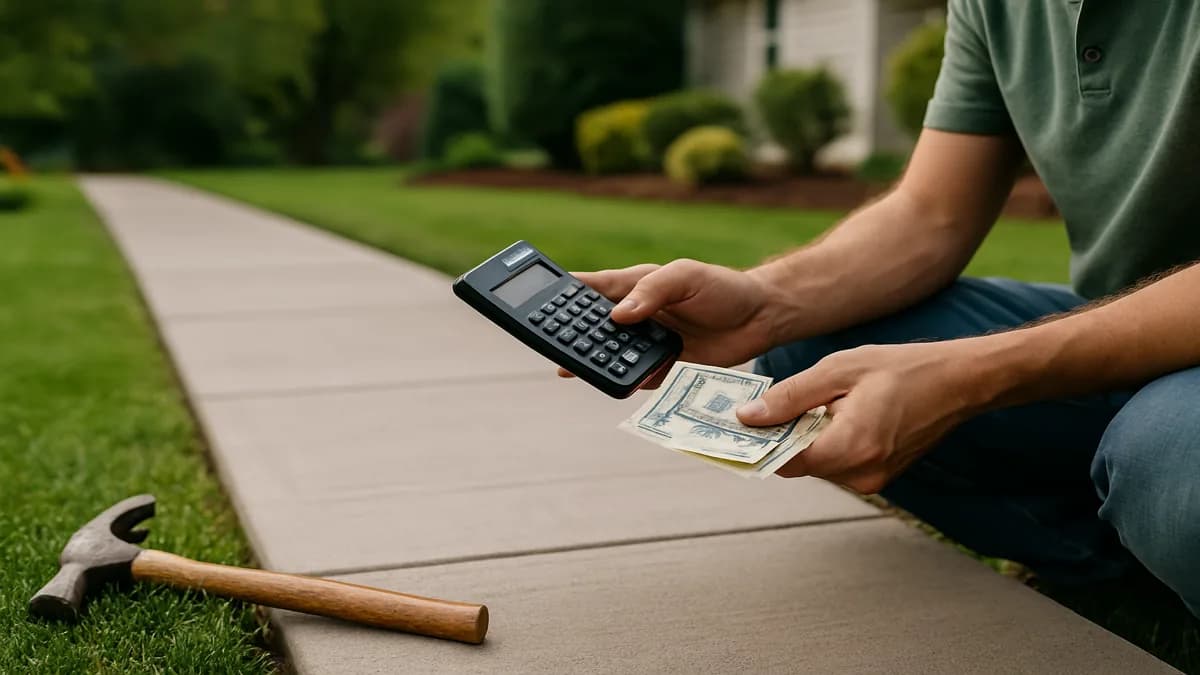
Concrete walkways run $7 to $16 per square foot installed. Public-right-of-way sidewalks cost more because they must meet municipal specifications for thickness, slope, and accessibility.
Every price here is a planning range, not a quote. Landscape pricing varies enormously by market, site access, and season, always get local bids before committing.
On this page
Concrete walkway cost is straightforward arithmetic once you know the width, but a sidewalk in the public right-of-way is a different job from a garden path, and it is priced differently.
Cost by size (opens in a new tab)
Average-cost market, 4-inch slab, plain broom finish:
| Walkway | Area | Typical installed cost |
|---|---|---|
| 3 ft × 20 ft | 60 sq ft | $420–960 |
| 3 ft × 40 ft | 120 sq ft | $840–1,920 |
| 4 ft × 30 ft | 120 sq ft | $840–1,920 |
| 4 ft × 50 ft | 200 sq ft | $1,400–3,200 |
| 5 ft × 60 ft | 300 sq ft | $2,100–4,800 |
Per linear foot, which is how walkways are often discussed:
| Width | Cost per linear ft |
|---|---|
| 3 ft | $21–48 |
| 4 ft | $28–64 |
| 5 ft | $35–80 |
Width (opens in a new tab)
Worth getting right, because it costs the same to build wrong.
| Width | Suits |
|---|---|
| 2–3 ft | Single file. Utility paths, side access |
| 4 ft | Two people side by side. The sensible default |
| 5 ft | Comfortable for two, and the common minimum for accessible public routes |
| 6 ft+ | Grand front entries |
Four feet is the width most people should build. Three feet forces single file and feels tight; five feet is generous and costs 25% more than four.
For accessible design, minimum widths and passing-space requirements apply to public routes. If the walkway is a required accessible route, check the applicable standard rather than guessing.
Public sidewalks (opens in a new tab)
If the walkway sits in the public right-of-way, typically the strip between the street and your property line, it is not simply your project.
Expect:
- A permit, and often a specified contractor list or bonding requirement
- Municipal specifications for width, thickness, cross slope, and jointing
- Accessibility requirements including cross slope limits and detectable warnings at crossings
- Inspection before and sometimes during the pour
- Restrictions on when work can happen
Cross slope matters more than people expect. Accessible-route standards cap sidewalk cross slope at a low percentage, and a sidewalk poured outside that tolerance can be rejected and require removal. This is a common reason DIY work in the right-of-way fails inspection.
Responsibility for maintenance varies. In many US cities the adjoining property owner maintains the sidewalk fronting their property and carries liability for injuries on it. Some cities operate cost-sharing or 50/50 repair programmes. Confirm with your public works department rather than assuming either way.
Repair versus replacement (opens in a new tab)
| Problem | Repair option | Typical cost |
|---|---|---|
| Settled slab, otherwise sound | Slab-jacking or foam lifting | $300–800 per slab |
| Trip hazard at a joint | Grinding | $100–300 per location |
| Small surface spalling | Patching | $150–400 |
| Cracked through, multiple slabs | Replacement | $500–1,500 per slab |
| Heaved by tree roots | Replace, and address roots | $600–2,000 per slab |
Slab-jacking pumps material under a settled slab to lift it back to grade. Where the concrete itself is sound and has simply dropped, it costs roughly half of replacement and takes hours rather than days.
Tree root heave is the case where repair alone rarely holds. Replacing the slab without addressing the root leaves the same lift recurring within a few years. Options include root pruning, which risks the tree's stability and health, root barriers, or rerouting the path. An arborist is worth consulting before cutting significant roots.
Building it properly (opens in a new tab)
Call 811 before digging
Free and required in most of the US. Walkways commonly cross service lines.
Excavate and compact
Remove all topsoil and organic material. Compact the subgrade.
Lay and compact 4 inches of gravel base
Provides drainage and uniform bearing. Compact in lifts.
Form, with the right slopes
A slight cross slope sheds water. Keep it within accessible tolerance if the route needs to comply.
Pour 4 inches, 6 at driveway crossings
With reinforcement where vehicles cross.
Joint at 4 to 5 foot intervals
Walkway control joints go closer together than patio joints because the narrow strip cracks readily. Roughly the width of the walk is a common rule.
Broom finish across the direction of travel
Gives grip underfoot and sheds water.
Cure damp for several days
Strength comes from hydration, not drying.
Alternatives worth pricing (opens in a new tab)
| Surface | Installed / sq ft | Notes |
|---|---|---|
| Concrete | $7–16 | Cheapest hard surface, cracks permanently |
| Pavers | $15–34 | Resettable, no cracking, more expensive |
| Flagstone | $18–38 | Best appearance, highest labour |
| Gravel | $4–10 | Cheapest, needs edging and topping up |
| Stepping stones | $8–20 | Informal, easiest DIY |
| Decomposed granite | $6–14 | Firm when compacted, informal look |
Concrete's advantages for a walkway are cost, a seamless surface that clears easily, and low maintenance. Its disadvantage is that damage is permanent, and a walkway is narrow enough that a single crack is always visible.
Where to save (opens in a new tab)
Keep it straight. Curves need more forming labour and generate more waste.
Four feet, not five. A 25% saving for a width most people never notice.
Do the demolition and excavation yourself where permitted. Breaking out old concrete and hauling it is unskilled work billed at skilled rates. Check whether your municipality requires licensed work in the right-of-way before assuming this is available.
Combine with other concrete work. If you are also pouring a patio or a pad, doing it in one delivery avoids a second short-load fee and a second mobilisation.
Plain broom finish. Decorative finishes on a walkway add cost for a surface people mostly walk over without looking at.
Frequently asked questions
Calculators for this job
Concrete Calculator
Get cubic yards and exact bag counts for slabs, footings, cylindrical piers, and stairs, plus whether mixing bags or ordering ready-mix makes sense at your volume.
OpenGravel Calculator
Gravel is ordered by the ton but measured by volume, so this calculator gives you both. Pick your stone, enter the area and depth, and you'll get cubic yards, tons, and a delivered cost range.
OpenLandscaping Cost Calculator
Pick a project, enter its size, and set your market. You'll get a DIY material cost and an installed cost range, with the drivers behind the spread spelled out.
OpenKeep reading
How Much Does a Paver Walkway Cost?
Paver walkways run $15 to $34 per square foot installed, more per square foot than a patio because there is far more cutting and edging per unit of area.
5 min read
How Much Does a Concrete Patio Cost?
A plain broom-finished concrete patio runs $8 to $20 per square foot installed. Stamped and coloured roughly doubles that, and the finish choice matters less than the base and the control joints.
5 min read
How Much Does Landscaping Cost?
Landscaping costs vary more by market and site access than by anything on a spec sheet. A full front-yard renovation commonly lands between $5,000 and $25,000, and the spread is mostly excavation, access, and disposal.
6 min read
Spotted something out of date or wrong? Tell us , we correct guides rather than leaving them to rot.